IN THIS LESSON
Tantra and Tibet · Lesson 7 of 7
The Book of the Dead, the Exile and the West
Death, loss and the long Western dream of Tibet. The bardo and the text read to the dead, revealed as treasure in the fourteenth century; sky burial; how Evans-Wentz made it 'The Tibetan Book of the Dead' and Jung and Leary read it; the Masters of Theosophy, David-Néel in Lhasa, Shangri-La and the hoax of Lobsang Rampa; the invasion of 1950, the flight of 1959 and the exile; Tibetan teachers in the West, and the scandals; the question of the next Dalai Lama; and how to approach a living tradition.
The last lesson follows the tradition through death, and through the near-death of Tibet itself. It ends where most readers of this course begin: in the West, and with the question of how to approach a living religion from outside.
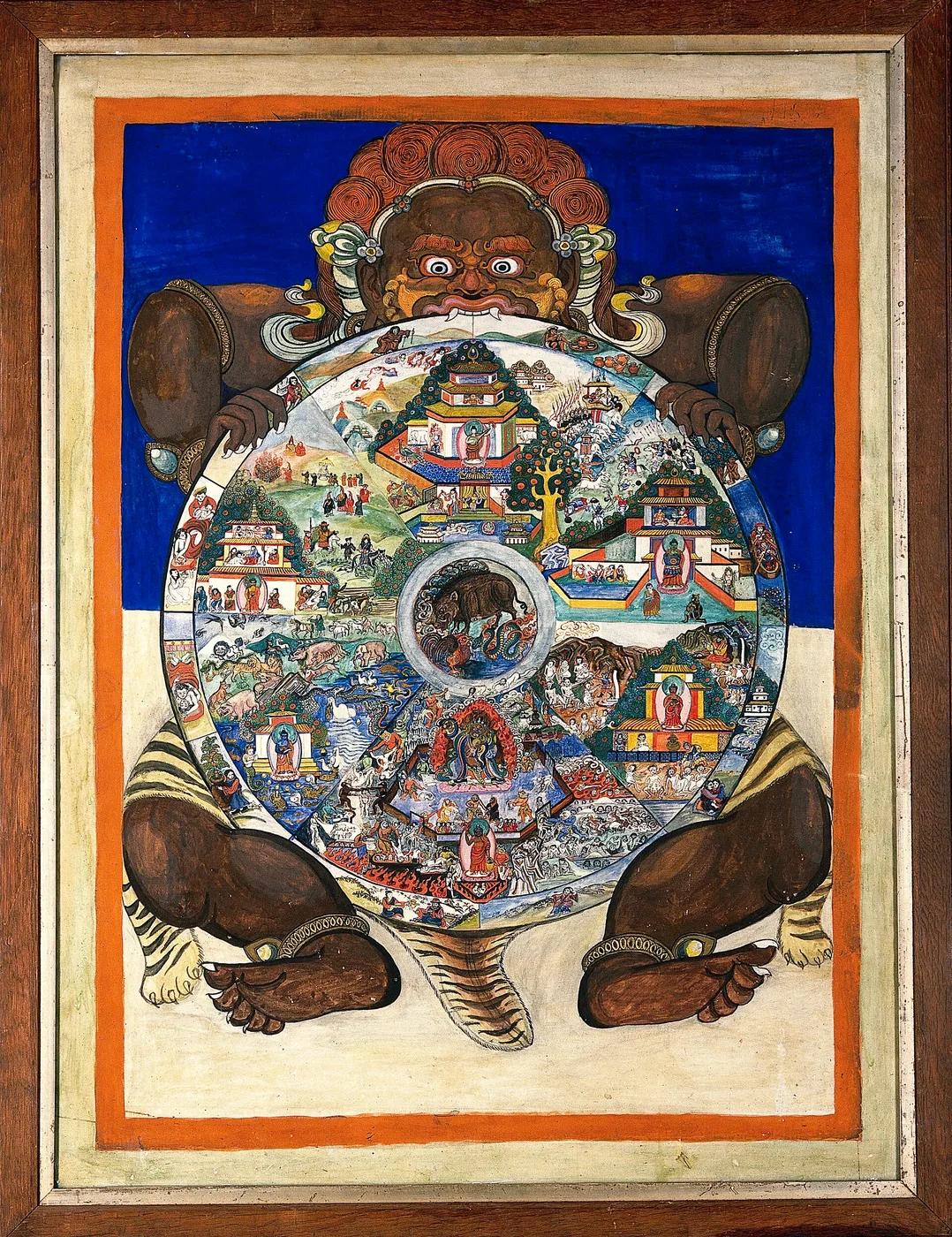
The bardo
Tibetan Buddhism teaches that between death and rebirth the mind passes through an intermediate state, a bardo, lasting up to forty-nine days. It is a dangerous time and also an opportunity: a mind that recognises what it meets can be liberated. A lama or friend reads aloud to the dying and the dead the instructions of a text called Bardo Thödol, "Liberation through Hearing in the Intermediate State".
The text belongs to a larger cycle of teachings on the peaceful and wrathful deities, said to have been hidden by Padmasambhava and revealed as terma by the treasure-finder Karma Lingpa (1326–1386) (The Diamond Vehicle Comes to Tibet). It describes the stages of death: the dissolving of the elements, the dawning of the clear light at the moment of death, which the trained recognise as the nature of their own mind; then visions of the forty-two peaceful and fifty-eight wrathful deities, which the dead are told are projections of their own mind, not to be fled; and finally the bardo of becoming, in which the mind is drawn towards a womb and a new life, and can still choose a better one. The practices of dream, clear light and transference among the Six Yogas prepare for this passage (Kuṇḍalinī, Haṭha Yoga and the Six Yogas).
In much of Tibet, where wood was scarce and the ground often frozen, bodies were given to the vultures on high open places, after being cut up by specialists: the "sky burial", jhator, a last act of generosity. Great lamas were cremated or embalmed and placed in stupas.
Lesson 7 of 7 · 17 min