The English Physician Enlarged · G
Garlick to Groundsel
Garlick
The offensiveness of the breath of him that hath eaten Garlick, will lead you by the nose to the knowledge hereof, and (instead of a description) direct you to the place where it grows in gardens, which kinds are the best, and most physical.
Government and virtues.] Mars owns this herb. This was anciently accounted the poor man’s treacle, it being a remedy for all diseases and hurts (except those which itself breed.) It provokes urine, and women’s courses, helps the biting of mad dogs and other venomous creatures, kills worms in children, cuts and voids tough phlegm, purges the head, helps the lethargy, is a good preservative against, and a remedy for any plague, sore, or foul ulcers; takes away spots and blemishes in the skin, eases pains in the ears, ripens and breaks imposthumes, or other swellings. And for all those diseases the onions are as effectual. But the Garlick hath some more peculier virtues besides the former, viz. it hath a special quality to discuss inconveniences coming by corrupt agues or mineral vapours; or by drinking corrupt and stinking waters; as also by taking wolf-bane, henbane, hemlock, or other poisonous and dangerous herbs. It is also held good in hydropick diseases, the jaundice, falling sickness, cramps, convulsions, the piles or hæmorrhoids, or other cold diseases. Many authors quote many diseases this is good for; but conceal its vices. Its heat is very vehement, and all vehement hot things send up but ill-favoured vapours to the brain. In coleric men it will add fuel to the fire; in men oppressed by melancholy, it will attenuate the humour, and send up strong fancies, and as many strange visions to the head; therefore let it be taken inwardly with great moderation; outwardly you may make more bold with it.
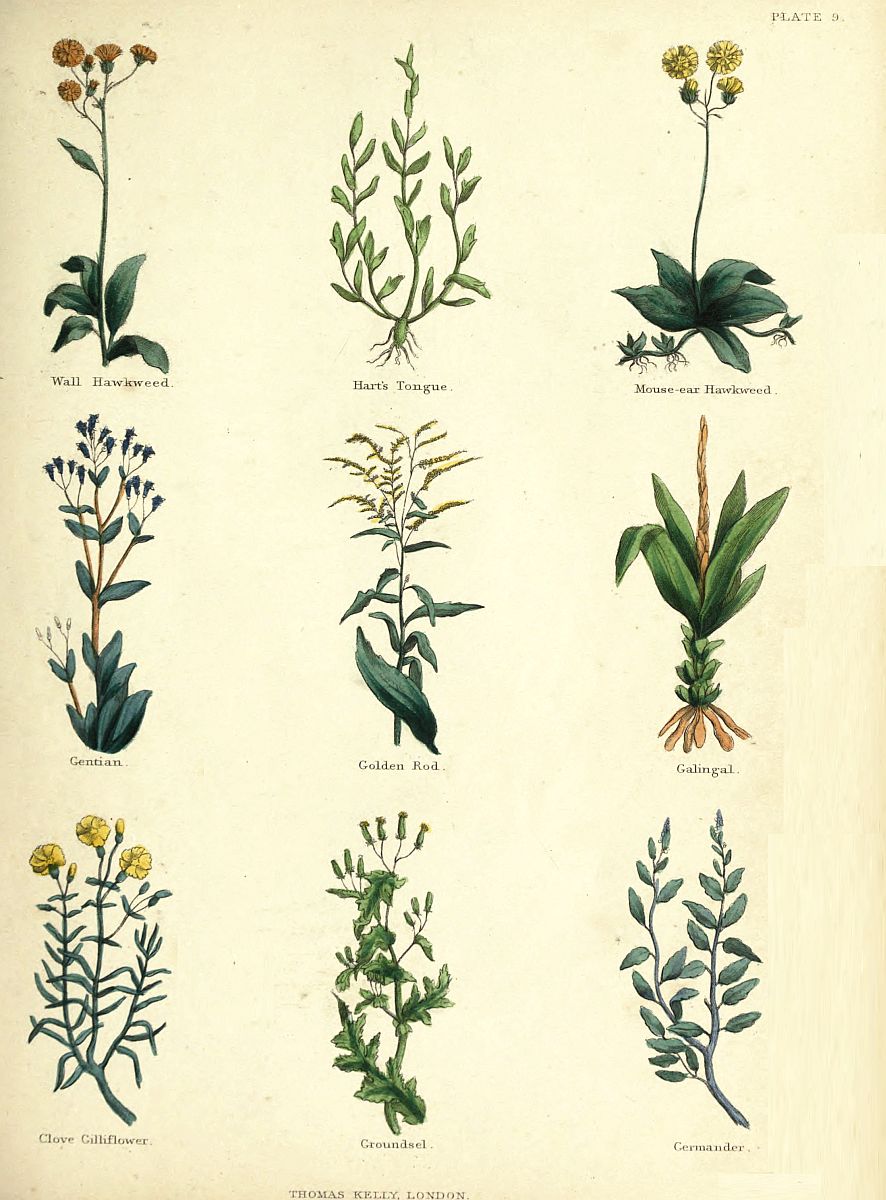
Wall Hawkweed, Hart’s Tongue, Mouse-ear Hawkweed; Gentian, Golden Rod, Galingal; Clove Gilliflower, Groundsel, Germander
Gentian, Felwort, or Baldmony
It is confessed that Gentian, which is most used amongst us, is brought over from beyond sea, yet we have two sorts of it growing frequently in our nation, which, besides the reasons so frequently alledged why English herbs should be fittest for English bodies, has been proved by the experience of divers physicians, to be not a wit inferior in virtue to that which comes from beyond sea, therefore be pleased to take the description of them as follows.
Descript.] The greater of the two hath many small long roots thrust down deep into the ground, and abiding all the Winter. The stalks are sometimes more, sometimes fewer, of a brownish green colour, which is sometimes two feet high, if the ground be fruitful, having many long, narrow, dark green leaves, set by couples up to the top; the flowers are long and hollow, of a purple colour, ending in fine corners. The smaller sort which is to be found in our land, grows up with sundry stalks, not a foot high, parted into several small branches, whereon grow divers small leaves together, very like those of the lesser Centaury, of a whitish green colour; on the tops of these stalks grow divers perfect blue flowers, standing in long husks, but not so big as the other; the root is very small, and full of threads.
Place.] The first grows in divers places of both the East and West counties, and as well in wet as in dry grounds; as near Longfield, by Gravesend, near Cobham in Kent, near Lillinstone in Kent, also in a chalk pit hard by a paper-mill not far from Dartford in Kent. The second grows also in divers places in Kent, as about Southfleet, and Longfield; upon Barton’s hills in Bedfordshire; also not far from St. Albans, upon a piece of waste chalky ground, as you go out by Dunstable way towards Gorhambury.
Time.] They flower in August.
Government and virtues.] They are under the dominion of Mars, and one of the principal herbs he is ruler of. They resist putrefactions, poison, and a more sure remedy cannot be found to prevent the pestilence than it is; it strengthens the stomach exceedingly, helps digestion, comforts the heart, and preserves it against faintings and swoonings: The powder of the dry roots helps the biting of mad dogs and venomous beasts, opens obstructions of the liver, and restores an appetite for their meat to such as have lost it. The herb steeped in wine, and the wine drank, refreshes such as be over-weary with traveling, and grow lame in their joints, either by cold or evil lodgings; it helps stitches, and griping pains in the sides; is an excellent remedy for such as are bruised by falls; it provokes urine and the terms exceedingly, therefore let it not be given to women with child: The same is very profitable for such as are troubled with cramps and convulsions, to drink the decoction: Also they say it breaks the stone, and helps ruptures most certainly: it is excellent in all cold diseases, and such as are troubled with tough phlegm, scabs, itch, or any fretting sores and ulcers; it is an admirable remedy to kill the worms, by taking half a dram of the powder in a morning in any convenient liquor; the same is excellently good to be taken inwardly for the king’s evil. It helps agues of all sorts, and the yellow jaundice, as also the bots in cattle; when kine are bitten on the udder by any venomous beast, do but stroke the place with the decoction of any of these, and it will instantly heal them.
Clove Gilliflowers
It is vain to describe an herb so well known.
Government and virtues.] They are gallant, fine, temperate flowers, of the nature and under the dominion of Jupiter; yea, so temperate, that no excess, neither in heat, cold, dryness, nor moisture, can be perceived in them; they are great strengtheners both of the brain and heart, and will therefore serve either for cordials or cephalics, as your occasion will serve. There is both a syrup and a conserve made of them alone, commonly to be had at every apothecary’s. To take now and then a little of either, strengthens nature much, in such as are in consumptions. They are also excellently good in hot pestilent fevers, and expel poison.
Germander
Descript.] Common Germander shoots forth sundry stalks, with small and somewhat round leaves, dented about the edges. The flowers stand at the tops of a deep purple colour. The root is composed of divers sprigs, which shoots forth a great way round about, quickly overspreading a garden.
Place.] It grows usually with us in gardens.
Time.] And flowers in June and July.
Government and virtues.] It is a most prevalent herb of Mercury, and strengthens the brain and apprehension exceedingly when weak, and relieves them when drooping. This taken with honey (saith Dioscorides) is a remedy for coughs, hardness of the spleen and difficulty of urine, and helps those that are fallen into a dropsy, especially at the beginning of the disease, a decoction being made thereof when it is green, and drank. It also brings down women’s courses, and expels the dead child. It is most effectual against the poison of all serpents, being drank in wine, and the bruised herb outwardly applied; used with honey, it cleanses old and foul ulcers; and made into an oil, and the eyes anointed therewith, takes away the dimness and moistness. It is likewise good for the pains in the sides and cramps. The decoction thereof taken for four days together, drives away and cures both tertain and quartan agues. It is also good against all diseases of the brain, as continual head-ache, falling-sickness, melancholy, drowsiness and dullness of the spirits, convulsions and palsies. A dram of the seed taken in powder purges by urine, and is good against the yellow jaundice. The juice of the leaves dropped into the ears kills the worms in them. The tops thereof, when they are in flowers, steeped twenty-four hours in a draught of white wine, and drank, kills the worms in the belly.
Stinking Gladwin
Descript.] This is one of the kinds of Flower-de-luce, having divers leaves arising from the roots, very like a Flower-de-luce, but that they are sharp-edged on both sides, and thicker in the middle, of a deeper green colour narrower and sharper pointed, and a strong ill-scent, if they be bruised between the fingers. In the middle rises up a reasonably strong stalk, a yard high at least, bearing three or four flowers at the top, made somewhat like the flowers of the Flower-de-luce, with three upright leaves, of a dead purplish ash-colour, with some veins discoloured in them; the other three do not fall down, nor are the three other small ones so arched, nor cover the lower leaves as the Flower-de-luce doth, but stand loose or asunder from them. After they are past, there come up three square hard husks, opening wide into three parts when they are ripe, wherein lie reddish seed, turns black when it hath abiden long. The root is like that of the Flower-de-luce, but reddish on the outside, and whitish within, very sharp and hot in the taste, of as evil a scent as the leaves.
Place.] This grows as well in upland grounds, as in moist places, woods, and shadowy places by the sea-side in many places of this land, and is usually nursed up in gardens.
Time.] It flowers not until July, and the seed is ripe in August or September, yet the husks after they are ripe, opening themselves, will hold their seed with them for two or three months, and not shed them.
Government and virtues.] It is supposed to be under the dominion of Saturn. It is used by many country people to purge corrupt phlegm and choler, which they do by drinking the decoction of the roots; and some to make it more gentle, do but infuse the sliced roots in ale; and some take the leaves, which serve well for the weaker stomach: The juice hereof put up, or snuffed up the nose, causes sneezing, and draws from the head much corruption; and the powder thereof doth the same. The powder thereof drank in wine, helps those that are troubled with the cramps and convulsions, or with the gout and sciatica, and gives ease to those that have griping pains in their body and belly, and helps those that have the stranguary. It is given with much profit to those that have had long fluxes by the sharp and evil quality of humours, which it stays, having first cleansed and purged them by the drying and binding property therein. The root boiled in wine and drank, doth effectually procure women’s courses, and used as a pessary, works the same effect, but causes abortion in women with child. Half a dram of the seed beaten to powder, and taken in wine, doth speedily cause one to make water abundantly. The same taken with vinegar, dissolves the hardness and swellings of the spleen. The root is very effectual in all wounds, especially of the head; as also to draw forth any splinters, thorns, or broken bones, or any other thing sticking in the flesh, without causing pains, being used with a little verdigrease and honey, and the great Centaury root. The same boiled in vinegar, and laid upon an eruption or swelling, doth very effectually dissolve and consume them; yea, even the swellings of the throat called the king’s evil; the juice of the leaves or roots heals the itch, and all running or spreading scabs, sores, blemishes, or scars in the skin, wheresoever they be.
Golden Rod
Descript.] This rises up with brownish small round stalks, two feet high, and sometimes more, having thereon many narrow and long dark green leaves, very seldom with any dents about the edges, or any stalks or white spots therein, yet they are sometimes so found divided at the tops into many small branches, with divers small yellow flowers on every one of them, all which are turned one way, and being ripe, do turn into down, and are carried away by the wind. The root consists of many small fibres, which grows not deep in the ground, but abides all the winter therein, shooting forth new branches every year, the old one lying down to the ground.
Place.] It grows in the open places of woods and copses, on both moist and dry grounds, in many places of this land.
Time.] It flowers about the month of July.
Government and virtues.] Venus claims the herb, and therefore to be sure it respects beauty lost. Arnoldus de Villa Nova commends it much against the stone in the reins and kidneys, and to provoke urine in abundance, whereby also the gravel and stone may be voided. The decoction of the herb, green or dry, or the distilled water thereof, is very effectual for inward bruises, as also to be outwardly applied, it stays bleeding in any part of the body, and of wounds; also the fluxes of humours, the bloody-flux, and women’s courses; and is no less prevalent in all ruptures or burstings, being drank inwardly, and outwardly applied. It is a sovereign wound herb, inferior to none, both for the inward and outward hurts; green wounds, old sores and ulcers, are quickly cured therewith. It also is of especial use in all lotions for sores or ulcers in the mouth, throat, or privy parts of man or woman. The decoction also helps to fasten the teeth that are loose in the gums.
Gout-wort, or Herb Gerrard
Descript.] It is a low herb, seldom rising half a yard high, having sundry leaves standing on brownish green stalks by three, snipped about, and of a strong unpleasant savour: The umbels of the flowers are white, and the seed blackish, the root runs in the ground, quickly taking a great deal of room.
Place.] It grows by hedge and wall-sides, and often in the border and corner of fields, and in gardens also.
Time.] It flowers and seeds about the end of July.
Government and virtues.] Saturn rules it. Neither is it to be supposed Gout-wort hath its name for nothing but upon experiment to heal the gout and sciatica; as also joint-aches, and other cold griefs. The very bearing of it about one eases the pains of the gout, and defends him that bears it from the disease.
Gromel
Of this I shall briefly describe their kinds, which are principally used in physic, the virtues whereof are alike, though somewhat different in their manner and form of growing.
Descript.] The greater Gromel grows up with slender hard and hairy stalks, trailing and taking root in the ground, as it lies thereon, and parted into many other small branches with hairy dark green leaves thereon. At the joints, with the leaves, come forth very small blue flowers, and after them hard stony roundish seed. The root is long and woody, abiding the Winter, and shoots forth fresh stalks in the spring.
The smaller wild Gromel sends forth divers upright hard branched stalks, two or three feet high full of joints, at every one of which grow small, long, hard, and rough leaves like the former, but less; among which leaves come forth small white flowers, and after them greyish round seed like the former; the root is not very big, but with many strings thereat.
The garden Gromel as divers upright, slender, woody, hairy stalks, blown and cressed, very little branched, with leaves like the former, and white flowers; after which, in rough brown husks, is contained a white, hard, round seed, shining like pearls, and greater than either the former; the root is like the first described, with divers branches and sprigs thereat, which continues (as the first doth) all the Winter.
Place.] The two first grow wild in barren or untilled places, and by the way side in many places of this land. The last is a nursling in the gardens of the curious.
Time.] They all flower from Midsummer until September sometimes, and in the mean time the seed ripens.
Government and virtues.] The herb belongs to Dame Venus; and therefore if Mars cause the cholic or stone, as usually he doth, if in Virgo, this is your cure. These are accounted to be of as singular force as any herb or seed whatsoever, to break the stone and to void it, and the gravel either in the reins or bladder, as also to provoke urine being stopped, and to help stranguary. The seed is of greatest use, being bruised and boiled in white wine or in broth, or the like, or the powder of the seed taken therein. Two drams of the seed in powder taken with women’s breast milk, is very effectual to procure a very speedy delivery to such women as have sore pains in their travail, and cannot be delivered: The herb itself, (when the seed is not to be had) either boiled, or the juice thereof drank, is effectual to all the purposes aforesaid, but not so powerful or speedy in operation.
Gooseberry Bush
Called also Feapberry, and in Sussex Dewberry-Bush, and in some Counties Wineberry.
Government and virtues.] They are under the dominion of Venus. The berries, while they are unripe, being scalded or baked, are good to stir up a fainting or decayed appetite, especially such whose stomachs are afflicted by choleric humours: They are excellently good to stay longings of women with child. You may keep them preserved with sugar all the year long. The decoction of the leaves of the tree cools hot dwellings and inflammations; as also St. Anthony’s fire. The ripe Gooseberries being eaten, are an excellent remedy to allay the violent heat both of the stomach and liver. The young and tender leaves break the stone, and expel gravel both from the kidneys and bladder. All the evil they do to the body of man is, they are supposed to breed crudities, and by crudities, worms.
Winter-green
Descript.] This sends forth seven, eight, or nine leaves from a small brown creeping root, every one standing upon a long foot stalk, which are almost as broad as long, round pointed, of a sad green colour, and hard in handling, and like the leaf of a Pear-tree; from whence arises a slender weak stalk, yet standing upright, bearing at the top many small white sweet-smelling flowers, laid open like a star, consisting of five round pointed leaves, with many yellow threads standing in the middle about a green head, and a long stalk with them, which in time grows to be the seed-vessel, which being ripe is found five square, with a small point at it, wherein is contained seed as small as dust.
Place.] It grows seldom in fields, but frequent in the woods northwards, viz. in Yorkshire, Lancashire, and Scotland.
Time.] It flowers about June and July.
Government and virtues.] Winter-green is under the dominion of Saturn, and is a singularly good wound herb, and an especial remedy for healing green wounds speedily, the green leaves being bruised and applied, or the juice of them. A salve made of the green herb stamped, or the juice boiled with hog’s lard, or with salad oil and wax, and some turpentine added to it, is a sovereign salve, and highly extolled by the Germans, who use it to heal all manner of wounds and sores. The herb boiled in wine and water, and given to drink to them that have any inward ulcers in their kidneys, or neck of the bladder, doth wonderfully help them. It stays all fluxes, as the lask, bloody fluxes, women’s courses, and bleeding of wounds, and takes away any inflammations rising upon pains of the heart; it is no less helpful for foul ulcers hard to be cured; as also for cankers or fistulas. The distilled water of the herb effectually performs the same things.
Groundsel
Descript.] Our common Groundsel has a round green and somewhat brownish stalk, spreading toward the top into branches, set with long and somewhat narrow green leaves, cut in on the edges, somewhat like the oak-leaves, but less, and round at the end. At the tops of the branches stand many small green heads, out of which grow several small, yellow threads or thumbs, which are the flowers, and continue many days blown in that manner, before it pass away into down, and with the seed is carried away in the wind. The root is small and thready, and soon perishes, and as soon rises again of its own sowing, so that it may be seen many months in the year both green and in flower, and seed; for it will spring and seed twice in a year at least, if it be suffered in a garden.
Place.] They grow almost every where, as well on tops of walls, as at the foot amongst rubbish and untilled grounds, but especially in gardens.
Time.] It flowers, as was said before, almost every month throughout the year.
Government and virtues.] This herb is Venus’s mistress-piece, and is as gallant and universal a medicine for all diseases coming of heat, in what part of the body soever they be, as the sun shines upon; it is very safe and friendly to the body of man: yet causes vomiting if the stomach be afflicted; if not, purging: and it doth it with more gentleness than can be expected; it is moist, and something cold withal, thereby causing expulsion, and repressing the heat caused by the motion of the internal parts in purges and vomits. Lay by our learned receipts; take so much Sena, so much Scammony, so much Colocynthis, so much infusion of Crocus Metallorum, &c. this herb alone preserved in a syrup, in a distilled water, or in an ointment, shall do the deed for you in all hot diseases, and, shall do it, 1, Safely; 2, Speedily.
The decoction of this herb (saith Dioscorides) made with wine, and drank, helps the pains of the stomach, proceeding of choler, (which it may well do by a vomit) as daily experience shews. The juice thereof taken in drink, or the decoction of it in ale, gently performs the same. It is good against the jaundice and falling sickness, being taken in wine; as also against difficulty of making water. It provokes urine, expels gravel in the reins or kidneys; a dram thereof given in oxymel, after some walking or stirring of the body. It helps also the sciatica, griping of the belly, the cholic, defects of the liver, and provokes women’s courses. The fresh herb boiled and made into a poultice, applied to the breasts of women that are swollen with pain and heat, as also the privy parts of man or woman, the seat or fundament, or the arteries, joints, and sinews, when they are inflamed and swollen, doth much ease them; and used with some salt, helps to dissolve knots or kernels in any part of the body. The juice of the herb, or as (Dioscorides saith) the leaves and flowers, with some fine Frankincense in powder, used in wounds of the body, nerves or sinews, doth singularly help to heal them. The distilled water of the herb performs well all the aforesaid cures, but especially for inflammations or watering of the eyes, by reason of the defluxion of rheum unto them.
The end of G: Garlick to Groundsel.
Turn the page for Heart’s-ease to Holly.
Tap or click the right-hand side of the book to turn the page, the left to turn back; or use the arrow keys, or swipe. Press F for full screen.
The English Physician Enlarged · G
Garlick to Groundsel
Garlick
The offensiveness of the breath of him that hath eaten Garlick, will lead you by the nose to the knowledge hereof, and (instead of a description) direct you to the place where it grows in gardens, which kinds are the best, and most physical.
Government and virtues.] Mars owns this herb. This was anciently accounted the poor man’s treacle, it being a remedy for all diseases and hurts (except those which itself breed.) It provokes urine, and women’s courses, helps the biting of mad dogs and other venomous creatures, kills worms in children, cuts and voids tough phlegm, purges the head, helps the lethargy, is a good preservative against, and a remedy for any plague, sore, or foul ulcers; takes away spots and blemishes in the skin, eases pains in the ears, ripens and breaks imposthumes, or other swellings. And for all those diseases the onions are as effectual. But the Garlick hath some more peculier virtues besides the former, viz. it hath a special quality to discuss inconveniences coming by corrupt agues or mineral vapours; or by drinking corrupt and stinking waters; as also by taking wolf-bane, henbane, hemlock, or other poisonous and dangerous herbs. It is also held good in hydropick diseases, the jaundice, falling sickness, cramps, convulsions, the piles or hæmorrhoids, or other cold diseases. Many authors quote many diseases this is good for; but conceal its vices. Its heat is very vehement, and all vehement hot things send up but ill-favoured vapours to the brain. In coleric men it will add fuel to the fire; in men oppressed by melancholy, it will attenuate the humour, and send up strong fancies, and as many strange visions to the head; therefore let it be taken inwardly with great moderation; outwardly you may make more bold with it.
Wall Hawkweed, Hart’s Tongue, Mouse-ear Hawkweed; Gentian, Golden Rod, Galingal; Clove Gilliflower, Groundsel, Germander
Gentian, Felwort, or Baldmony
It is confessed that Gentian, which is most used amongst us, is brought over from beyond sea, yet we have two sorts of it growing frequently in our nation, which, besides the reasons so frequently alledged why English herbs should be fittest for English bodies, has been proved by the experience of divers physicians, to be not a wit inferior in virtue to that which comes from beyond sea, therefore be pleased to take the description of them as follows.
Descript.] The greater of the two hath many small long roots thrust down deep into the ground, and abiding all the Winter. The stalks are sometimes more, sometimes fewer, of a brownish green colour, which is sometimes two feet high, if the ground be fruitful, having many long, narrow, dark green leaves, set by couples up to the top; the flowers are long and hollow, of a purple colour, ending in fine corners. The smaller sort which is to be found in our land, grows up with sundry stalks, not a foot high, parted into several small branches, whereon grow divers small leaves together, very like those of the lesser Centaury, of a whitish green colour; on the tops of these stalks grow divers perfect blue flowers, standing in long husks, but not so big as the other; the root is very small, and full of threads.
Place.] The first grows in divers places of both the East and West counties, and as well in wet as in dry grounds; as near Longfield, by Gravesend, near Cobham in Kent, near Lillinstone in Kent, also in a chalk pit hard by a paper-mill not far from Dartford in Kent. The second grows also in divers places in Kent, as about Southfleet, and Longfield; upon Barton’s hills in Bedfordshire; also not far from St. Albans, upon a piece of waste chalky ground, as you go out by Dunstable way towards Gorhambury.
Time.] They flower in August.
Government and virtues.] They are under the dominion of Mars, and one of the principal herbs he is ruler of. They resist putrefactions, poison, and a more sure remedy cannot be found to prevent the pestilence than it is; it strengthens the stomach exceedingly, helps digestion, comforts the heart, and preserves it against faintings and swoonings: The powder of the dry roots helps the biting of mad dogs and venomous beasts, opens obstructions of the liver, and restores an appetite for their meat to such as have lost it. The herb steeped in wine, and the wine drank, refreshes such as be over-weary with traveling, and grow lame in their joints, either by cold or evil lodgings; it helps stitches, and griping pains in the sides; is an excellent remedy for such as are bruised by falls; it provokes urine and the terms exceedingly, therefore let it not be given to women with child: The same is very profitable for such as are troubled with cramps and convulsions, to drink the decoction: Also they say it breaks the stone, and helps ruptures most certainly: it is excellent in all cold diseases, and such as are troubled with tough phlegm, scabs, itch, or any fretting sores and ulcers; it is an admirable remedy to kill the worms, by taking half a dram of the powder in a morning in any convenient liquor; the same is excellently good to be taken inwardly for the king’s evil. It helps agues of all sorts, and the yellow jaundice, as also the bots in cattle; when kine are bitten on the udder by any venomous beast, do but stroke the place with the decoction of any of these, and it will instantly heal them.
Clove Gilliflowers
It is vain to describe an herb so well known.
Government and virtues.] They are gallant, fine, temperate flowers, of the nature and under the dominion of Jupiter; yea, so temperate, that no excess, neither in heat, cold, dryness, nor moisture, can be perceived in them; they are great strengtheners both of the brain and heart, and will therefore serve either for cordials or cephalics, as your occasion will serve. There is both a syrup and a conserve made of them alone, commonly to be had at every apothecary’s. To take now and then a little of either, strengthens nature much, in such as are in consumptions. They are also excellently good in hot pestilent fevers, and expel poison.
Germander
Descript.] Common Germander shoots forth sundry stalks, with small and somewhat round leaves, dented about the edges. The flowers stand at the tops of a deep purple colour. The root is composed of divers sprigs, which shoots forth a great way round about, quickly overspreading a garden.
Place.] It grows usually with us in gardens.
Time.] And flowers in June and July.
Government and virtues.] It is a most prevalent herb of Mercury, and strengthens the brain and apprehension exceedingly when weak, and relieves them when drooping. This taken with honey (saith Dioscorides) is a remedy for coughs, hardness of the spleen and difficulty of urine, and helps those that are fallen into a dropsy, especially at the beginning of the disease, a decoction being made thereof when it is green, and drank. It also brings down women’s courses, and expels the dead child. It is most effectual against the poison of all serpents, being drank in wine, and the bruised herb outwardly applied; used with honey, it cleanses old and foul ulcers; and made into an oil, and the eyes anointed therewith, takes away the dimness and moistness. It is likewise good for the pains in the sides and cramps. The decoction thereof taken for four days together, drives away and cures both tertain and quartan agues. It is also good against all diseases of the brain, as continual head-ache, falling-sickness, melancholy, drowsiness and dullness of the spirits, convulsions and palsies. A dram of the seed taken in powder purges by urine, and is good against the yellow jaundice. The juice of the leaves dropped into the ears kills the worms in them. The tops thereof, when they are in flowers, steeped twenty-four hours in a draught of white wine, and drank, kills the worms in the belly.
Stinking Gladwin
Descript.] This is one of the kinds of Flower-de-luce, having divers leaves arising from the roots, very like a Flower-de-luce, but that they are sharp-edged on both sides, and thicker in the middle, of a deeper green colour narrower and sharper pointed, and a strong ill-scent, if they be bruised between the fingers. In the middle rises up a reasonably strong stalk, a yard high at least, bearing three or four flowers at the top, made somewhat like the flowers of the Flower-de-luce, with three upright leaves, of a dead purplish ash-colour, with some veins discoloured in them; the other three do not fall down, nor are the three other small ones so arched, nor cover the lower leaves as the Flower-de-luce doth, but stand loose or asunder from them. After they are past, there come up three square hard husks, opening wide into three parts when they are ripe, wherein lie reddish seed, turns black when it hath abiden long. The root is like that of the Flower-de-luce, but reddish on the outside, and whitish within, very sharp and hot in the taste, of as evil a scent as the leaves.
Place.] This grows as well in upland grounds, as in moist places, woods, and shadowy places by the sea-side in many places of this land, and is usually nursed up in gardens.
Time.] It flowers not until July, and the seed is ripe in August or September, yet the husks after they are ripe, opening themselves, will hold their seed with them for two or three months, and not shed them.
Government and virtues.] It is supposed to be under the dominion of Saturn. It is used by many country people to purge corrupt phlegm and choler, which they do by drinking the decoction of the roots; and some to make it more gentle, do but infuse the sliced roots in ale; and some take the leaves, which serve well for the weaker stomach: The juice hereof put up, or snuffed up the nose, causes sneezing, and draws from the head much corruption; and the powder thereof doth the same. The powder thereof drank in wine, helps those that are troubled with the cramps and convulsions, or with the gout and sciatica, and gives ease to those that have griping pains in their body and belly, and helps those that have the stranguary. It is given with much profit to those that have had long fluxes by the sharp and evil quality of humours, which it stays, having first cleansed and purged them by the drying and binding property therein. The root boiled in wine and drank, doth effectually procure women’s courses, and used as a pessary, works the same effect, but causes abortion in women with child. Half a dram of the seed beaten to powder, and taken in wine, doth speedily cause one to make water abundantly. The same taken with vinegar, dissolves the hardness and swellings of the spleen. The root is very effectual in all wounds, especially of the head; as also to draw forth any splinters, thorns, or broken bones, or any other thing sticking in the flesh, without causing pains, being used with a little verdigrease and honey, and the great Centaury root. The same boiled in vinegar, and laid upon an eruption or swelling, doth very effectually dissolve and consume them; yea, even the swellings of the throat called the king’s evil; the juice of the leaves or roots heals the itch, and all running or spreading scabs, sores, blemishes, or scars in the skin, wheresoever they be.
Golden Rod
Descript.] This rises up with brownish small round stalks, two feet high, and sometimes more, having thereon many narrow and long dark green leaves, very seldom with any dents about the edges, or any stalks or white spots therein, yet they are sometimes so found divided at the tops into many small branches, with divers small yellow flowers on every one of them, all which are turned one way, and being ripe, do turn into down, and are carried away by the wind. The root consists of many small fibres, which grows not deep in the ground, but abides all the winter therein, shooting forth new branches every year, the old one lying down to the ground.
Place.] It grows in the open places of woods and copses, on both moist and dry grounds, in many places of this land.
Time.] It flowers about the month of July.
Government and virtues.] Venus claims the herb, and therefore to be sure it respects beauty lost. Arnoldus de Villa Nova commends it much against the stone in the reins and kidneys, and to provoke urine in abundance, whereby also the gravel and stone may be voided. The decoction of the herb, green or dry, or the distilled water thereof, is very effectual for inward bruises, as also to be outwardly applied, it stays bleeding in any part of the body, and of wounds; also the fluxes of humours, the bloody-flux, and women’s courses; and is no less prevalent in all ruptures or burstings, being drank inwardly, and outwardly applied. It is a sovereign wound herb, inferior to none, both for the inward and outward hurts; green wounds, old sores and ulcers, are quickly cured therewith. It also is of especial use in all lotions for sores or ulcers in the mouth, throat, or privy parts of man or woman. The decoction also helps to fasten the teeth that are loose in the gums.
Gout-wort, or Herb Gerrard
Descript.] It is a low herb, seldom rising half a yard high, having sundry leaves standing on brownish green stalks by three, snipped about, and of a strong unpleasant savour: The umbels of the flowers are white, and the seed blackish, the root runs in the ground, quickly taking a great deal of room.
Place.] It grows by hedge and wall-sides, and often in the border and corner of fields, and in gardens also.
Time.] It flowers and seeds about the end of July.
Government and virtues.] Saturn rules it. Neither is it to be supposed Gout-wort hath its name for nothing but upon experiment to heal the gout and sciatica; as also joint-aches, and other cold griefs. The very bearing of it about one eases the pains of the gout, and defends him that bears it from the disease.
Gromel
Of this I shall briefly describe their kinds, which are principally used in physic, the virtues whereof are alike, though somewhat different in their manner and form of growing.
Descript.] The greater Gromel grows up with slender hard and hairy stalks, trailing and taking root in the ground, as it lies thereon, and parted into many other small branches with hairy dark green leaves thereon. At the joints, with the leaves, come forth very small blue flowers, and after them hard stony roundish seed. The root is long and woody, abiding the Winter, and shoots forth fresh stalks in the spring.
The smaller wild Gromel sends forth divers upright hard branched stalks, two or three feet high full of joints, at every one of which grow small, long, hard, and rough leaves like the former, but less; among which leaves come forth small white flowers, and after them greyish round seed like the former; the root is not very big, but with many strings thereat.
The garden Gromel as divers upright, slender, woody, hairy stalks, blown and cressed, very little branched, with leaves like the former, and white flowers; after which, in rough brown husks, is contained a white, hard, round seed, shining like pearls, and greater than either the former; the root is like the first described, with divers branches and sprigs thereat, which continues (as the first doth) all the Winter.
Place.] The two first grow wild in barren or untilled places, and by the way side in many places of this land. The last is a nursling in the gardens of the curious.
Time.] They all flower from Midsummer until September sometimes, and in the mean time the seed ripens.
Government and virtues.] The herb belongs to Dame Venus; and therefore if Mars cause the cholic or stone, as usually he doth, if in Virgo, this is your cure. These are accounted to be of as singular force as any herb or seed whatsoever, to break the stone and to void it, and the gravel either in the reins or bladder, as also to provoke urine being stopped, and to help stranguary. The seed is of greatest use, being bruised and boiled in white wine or in broth, or the like, or the powder of the seed taken therein. Two drams of the seed in powder taken with women’s breast milk, is very effectual to procure a very speedy delivery to such women as have sore pains in their travail, and cannot be delivered: The herb itself, (when the seed is not to be had) either boiled, or the juice thereof drank, is effectual to all the purposes aforesaid, but not so powerful or speedy in operation.
Gooseberry Bush
Called also Feapberry, and in Sussex Dewberry-Bush, and in some Counties Wineberry.
Government and virtues.] They are under the dominion of Venus. The berries, while they are unripe, being scalded or baked, are good to stir up a fainting or decayed appetite, especially such whose stomachs are afflicted by choleric humours: They are excellently good to stay longings of women with child. You may keep them preserved with sugar all the year long. The decoction of the leaves of the tree cools hot dwellings and inflammations; as also St. Anthony’s fire. The ripe Gooseberries being eaten, are an excellent remedy to allay the violent heat both of the stomach and liver. The young and tender leaves break the stone, and expel gravel both from the kidneys and bladder. All the evil they do to the body of man is, they are supposed to breed crudities, and by crudities, worms.
Winter-green
Descript.] This sends forth seven, eight, or nine leaves from a small brown creeping root, every one standing upon a long foot stalk, which are almost as broad as long, round pointed, of a sad green colour, and hard in handling, and like the leaf of a Pear-tree; from whence arises a slender weak stalk, yet standing upright, bearing at the top many small white sweet-smelling flowers, laid open like a star, consisting of five round pointed leaves, with many yellow threads standing in the middle about a green head, and a long stalk with them, which in time grows to be the seed-vessel, which being ripe is found five square, with a small point at it, wherein is contained seed as small as dust.
Place.] It grows seldom in fields, but frequent in the woods northwards, viz. in Yorkshire, Lancashire, and Scotland.
Time.] It flowers about June and July.
Government and virtues.] Winter-green is under the dominion of Saturn, and is a singularly good wound herb, and an especial remedy for healing green wounds speedily, the green leaves being bruised and applied, or the juice of them. A salve made of the green herb stamped, or the juice boiled with hog’s lard, or with salad oil and wax, and some turpentine added to it, is a sovereign salve, and highly extolled by the Germans, who use it to heal all manner of wounds and sores. The herb boiled in wine and water, and given to drink to them that have any inward ulcers in their kidneys, or neck of the bladder, doth wonderfully help them. It stays all fluxes, as the lask, bloody fluxes, women’s courses, and bleeding of wounds, and takes away any inflammations rising upon pains of the heart; it is no less helpful for foul ulcers hard to be cured; as also for cankers or fistulas. The distilled water of the herb effectually performs the same things.
Groundsel
Descript.] Our common Groundsel has a round green and somewhat brownish stalk, spreading toward the top into branches, set with long and somewhat narrow green leaves, cut in on the edges, somewhat like the oak-leaves, but less, and round at the end. At the tops of the branches stand many small green heads, out of which grow several small, yellow threads or thumbs, which are the flowers, and continue many days blown in that manner, before it pass away into down, and with the seed is carried away in the wind. The root is small and thready, and soon perishes, and as soon rises again of its own sowing, so that it may be seen many months in the year both green and in flower, and seed; for it will spring and seed twice in a year at least, if it be suffered in a garden.
Place.] They grow almost every where, as well on tops of walls, as at the foot amongst rubbish and untilled grounds, but especially in gardens.
Time.] It flowers, as was said before, almost every month throughout the year.
Government and virtues.] This herb is Venus’s mistress-piece, and is as gallant and universal a medicine for all diseases coming of heat, in what part of the body soever they be, as the sun shines upon; it is very safe and friendly to the body of man: yet causes vomiting if the stomach be afflicted; if not, purging: and it doth it with more gentleness than can be expected; it is moist, and something cold withal, thereby causing expulsion, and repressing the heat caused by the motion of the internal parts in purges and vomits. Lay by our learned receipts; take so much Sena, so much Scammony, so much Colocynthis, so much infusion of Crocus Metallorum, &c. this herb alone preserved in a syrup, in a distilled water, or in an ointment, shall do the deed for you in all hot diseases, and, shall do it, 1, Safely; 2, Speedily.
The decoction of this herb (saith Dioscorides) made with wine, and drank, helps the pains of the stomach, proceeding of choler, (which it may well do by a vomit) as daily experience shews. The juice thereof taken in drink, or the decoction of it in ale, gently performs the same. It is good against the jaundice and falling sickness, being taken in wine; as also against difficulty of making water. It provokes urine, expels gravel in the reins or kidneys; a dram thereof given in oxymel, after some walking or stirring of the body. It helps also the sciatica, griping of the belly, the cholic, defects of the liver, and provokes women’s courses. The fresh herb boiled and made into a poultice, applied to the breasts of women that are swollen with pain and heat, as also the privy parts of man or woman, the seat or fundament, or the arteries, joints, and sinews, when they are inflamed and swollen, doth much ease them; and used with some salt, helps to dissolve knots or kernels in any part of the body. The juice of the herb, or as (Dioscorides saith) the leaves and flowers, with some fine Frankincense in powder, used in wounds of the body, nerves or sinews, doth singularly help to heal them. The distilled water of the herb performs well all the aforesaid cures, but especially for inflammations or watering of the eyes, by reason of the defluxion of rheum unto them.
9 of 42 · 17 min read