The English Physician Enlarged · F
Fern to Furze Bush
Fern
Descript.] Of this there are two kinds principally to be treated of, viz. the Male and Female. The Female grows higher than the Male, but the leaves thereof are smaller, and more divided and dented, and of as strong a smell as the male; the virtue of them are both alike, and therefore I shall not trouble you with any description or distinction of them.
Place.] They grow both in heaths and in shady places near the hedge-sides in all counties of this land.
Time.] They flower and give their seed at Midsummer.
The Female Fern is that plant which is in Sussex, called Brakes, the seed of which some authors hold to be so rare: Such a thing there is I know, and may be easily had upon Midsummer Eve, and for ought I know, two or three days after it, if not more.
Government and virtues.] It is under the dominion of Mercury, both Male and Female. The roots of both these sorts of Fern being bruised and boiled in Mead, or honeyed water, and drank, kills both the broad and long worms in the body, and abates the swelling and hardness of the spleen. The green leaves eaten, purge the belly of choleric and waterish humours that trouble the stomach. They are dangerous for women with child to meddle with, by reason they cause abortions. The roots bruised and boiled in oil, or hog’s grease, make a very profitable ointment to heal wounds, or pricks gotten in the flesh. The powder of them used in foul ulcers, dries up their malignant moisture, and causes their speedier healing. Fern being burned, the smoke thereof drives away serpents, gnats, and other noisome creatures, which in fenny countries do in the night time, trouble and molest people lying in their beds with their faces uncovered; it causes barrenness.
Osmond Royal, or Water Fern
Descript.] This shoots forth in Spring time (for in the Winter the leaves perish) divers rough hard stalks, half round, and yellowish, or flat on the other side, two feet high, having divers branches of winged yellowish green leaves on all sides, set one against another, longer, narrower, and not nicked on the edges as the former. From the top of some of these stalks grow forth a long bush of small and more yellow, green, scaly aglets, set in the same manner on the stalks as the leaves are, which are accounted the flowers and seeds. The root is rough, thick and scabby: with a white pith in the middle, which is called the heart thereof.
Place.] It grows on moors, bogs, and watery places, in many parts of this land.
Time.] It is green all the summer, and the root only abides in winter.
Government and virtues.] Saturn owns the plant. This has all the virtues mentioned in the former Ferns, and is much more effectual than they, both for inward and outward griefs, and is accounted singularly good in wounds, bruises, or the like. The decoction to be drank, or boiled into an ointment of oil, as a balsam or balm, and so it is singularly good against bruises, and bones broken, or out of joint, and gives much ease to the cholic and splenetic diseases: as also for ruptures or burstings. The decoction of the root in white wine, provokes urine exceedingly, and cleanses the bladder and passages of urine.
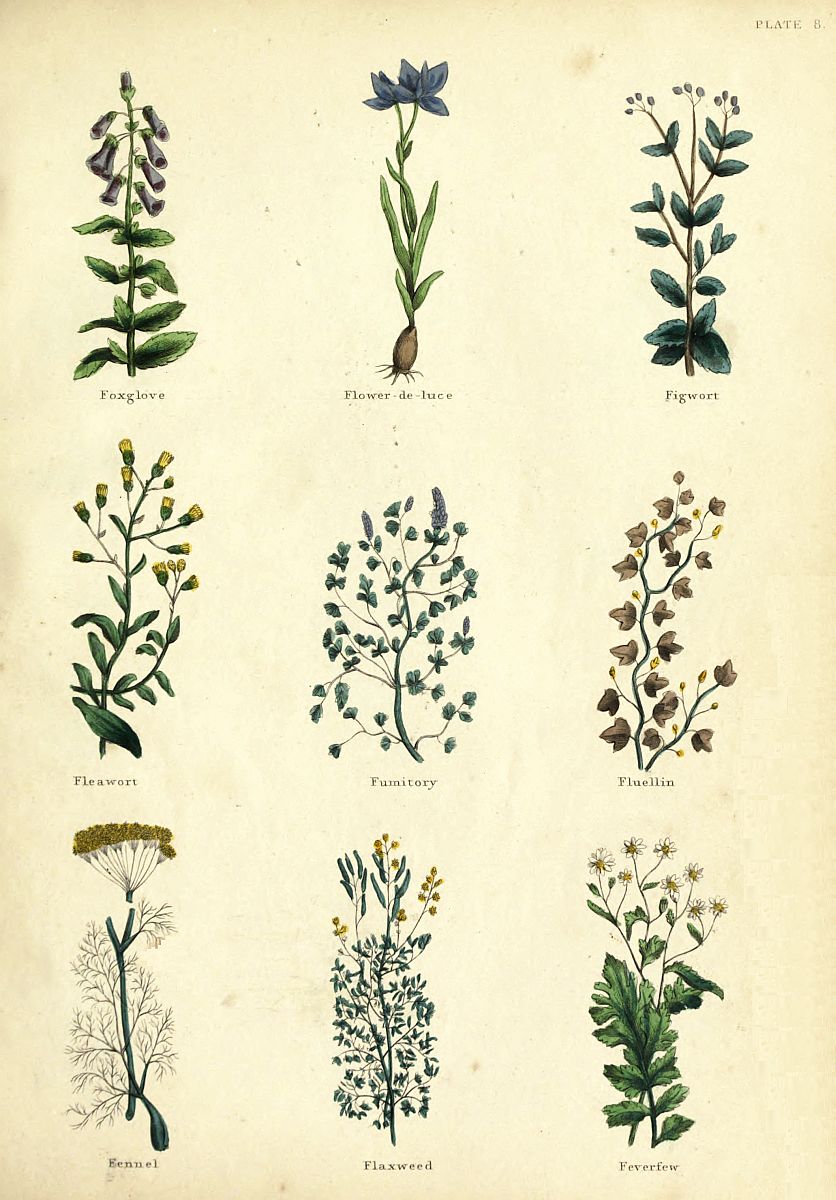
Foxglove, Flower-de-luce, Figwort; Fleawort, Fumitory, Fluellin; Fennel, Flaxweed, Feverfew
Feverfew or Featherfew
Descript.] Common Featherfew has large, fresh, green leaves, much torn or cut on the edges. The stalks are hard and round, set with many such like leaves, but smaller, and at the tops stand many single flowers, upon small foot stalks, consisting of many small white leaves standing round about a yellow thrum in the middle. The root is somewhat hard and short, with many strong fibres about it. The scent of the whole plant is very strong, and the taste is very bitter.
Place.] This grows wild in many places of the land, but is for the most part nourished in gardens.
Time.] It flowers in the months of June and July.
Government and virtues.] Venus commands this herb, and has commended it to succour her sisters (women) and to be a general strengthener of their wombs, and remedy such infirmities as a careless midwife hath there caused if they will but be pleased to make use of her herb boiled in white wine, and drink the decoction; it cleanses the womb, expels the after-birth, and doth a woman all the good she can desire of an herb. And if any grumble because they cannot get the herb in winter, tell them, if they please, they may make a syrup of it in summer; it is chiefly used for the disease of the mother, whether it be the strangling or rising of the mother, or hardness, or inflammation of the same, applied outwardly thereunto. Or a decoction of the flowers in wine, with a little Nutmeg or Mace put therein, and drank often in a day, is an approved remedy to bring down women’s courses speedily, and helps to expel the dead birth and after-birth. For a woman to sit over the hot fumes of the decoction of the herb made in water or wine, is effectual for the same; and in some cases to apply the boiled herb warm to the privy parts. The decoction thereof made with some sugar, or honey put thereto, is used by many with good success to help the cough and stuffing of the chest, by colds, as also to cleanse the reins and bladder, and helps to expel the stone in them. The powder of the herb taken in wine, with some Oxymel, purges both choler and phlegm, and is available for those that are short winded, and are troubled with melancholy and heaviness, or sadness of spirits. It is very effectual for all pains in the head coming of a cold cause, the herb being bruised and applied to the crown of the head: As also for the vertigo, that is a running or swimming in the head. The decoction thereof drank warm, and the herb bruised with a few corns of Bay salt, and applied to the wrists before the coming of the ague fits, doth take them away. The distilled water takes away freckles, and other spots and deformities in the face. The herb bruised and heated on a tile, with some wine to moisten it, or fried with a little wine and oil in a frying-pan, and applied warm outwardly to the places, helps the wind and cholic in the lower part of the belly. It is an especial remedy against opium taken too liberally.
Fennel
Every garden affords this so plentifully, that it needs no description.
Government and virtues.] One good old fashion is not yet left off, viz. to boil Fennel with fish; for it consumes that phlegmatic humour, which fish most plentifully afford and annoy the body with, though few that use it know wherefore they do it; I suppose the reason of its benefit this way is because it is an herb of Mercury, and under Virgo, and therefore bears antipathy to Pisces. Fennel is good to break wind, to provoke urine, and ease the pains of the stone, and helps to break it. The leaves or seed, boiled in barley water and drank are good for nurses, to increase their milk, and make it more wholesome for the child. The leaves, or rather the seeds, boiled in water, stays the hiccough, and takes away the loathings which oftentimes happen to the stomachs of sick and feverish persons and allays the heat thereof. The seed boiled in wine and drank, is good for those that are bitten with serpents, or have eaten poisonous herbs, or mushrooms. The seed and the roots much more, help to open obstructions of the liver, spleen, and gall, and thereby help the painful and windy swellings of the spleen, and the yellow jaundice; as also the gout and cramps. The seed is of good use in medicines to help shortness of breath and wheezing by stopping of the lungs. It helps also to bring down the courses, and to cleanse the parts after delivery. The roots are of most use in physic drinks, and broth that are taken to cleanse the blood, to open obstructions of the liver, to provoke urine, and amend the ill colour in the face after sickness, and to cause a good habit through the body. Both leaves, seeds, and roots thereof are much used in drink or broth, to make people more lean that are too fat. The distilled water of the whole herb, or the condensate juice dissolved, but especially the natural juice, that in some counties issues out hereof of its own accord, dropped into the eyes, cleanses them from mists and films that hinder the sight. The sweet Fennel is much weaker in physical uses than the common Fennel. The wild Fennel is stronger and hotter than the tame, and therefore most powerful against the stone, but not so effectual to encrease milk, because of its dryness.
Sow-fennel, or Hog’s-fennel
Besides the common name in English, Hog’s Fennel, and the Latin name Peucidanum, is called Hoar-strange, and Hoar-strong, Sulphur-wort, and Brimstone-wort.
Descript.] The common Sow-Fennel has divers branched stalks of thick and somewhat long leaves, three for the most part joined together at a place, among which arises a crested straight stalk, less than Fennel, with some joints thereon, and leaves growing thereat, and towards the tops some branches issuing from thence; likewise on the tops of the stalks and branches stand divers tufts of yellow flowers, whereafter grows somewhat flat, thin, and yellowish seed, bigger than Fennel seed. The roots grow great and deep, with many other parts and fibres about them of a strong scent like hot brimstone, and yield forth a yellowish milk, or clammy juice, almost like a gum.
Place.] It grows plentifully in the salt low marshes near Feversham in Kent.
Time.] It flowers plentifully in July and August.
Government and virtues.] This is also an herb of Mercury. The juice of Sow-Fennel (saith Dioscorides, and Galen,) used with vinegar and rose water, or the juice with a little Euphorbium put to the nose, helps those that are troubled with the lethargy, frenzy, giddiness of the head, the falling sickness, long and inveterate head-aches, the palsy, sciatica, and the cramp, and generally all the diseases of the sinews, used with oil and vinegar. The juice dissolved in wine, or put into an egg, is good for a cough, or shortness of breath, and for those that are troubled with wind in the body. It purges the belly gently, expels the hardness of the spleen, gives ease to women that have sore travail in child-birth, and eases the pains of the reins and bladder, and also the womb. A little of the juice dissolved in wine, and dropped into the ears, eases much of the pains in them, and put into a hollow tooth, eases the pain thereof. The root is less effectual to all the aforesaid disorders; yet the powder of the root cleanses foul ulcers, being put into them, and takes out splinters of broken bones, or other things in the flesh, and heals them up perfectly: as also, dries up old and inveterate running sores, and is of admirable virtue in all green wounds.
Fig-wort, or Throat-wort
Descript.] Common great Fig-wort sends divers great, strong, hard, square brown stalks, three or four feet high, whereon grow large, hard, and dark green leaves, two at a joint, harder and larger than Nettle leaves, but not stinking; at the tops of the stalks stand many purple flowers set in husks, which are sometimes gaping and open, somewhat like those of Water Betony; after which come hard round heads, with a small point in the middle, wherein lie small brownish seed. The root is great, white, and thick, with many branches at it, growing aslope under the upper crust of the ground, which abides many years, but keeps not his green leaves in Winter.
Place.] It grows frequently in moist and shadowy woods, and in the lower parts of the fields and meadows.
Time.] It flowers about July, and the seed will be ripe about a month after the flowers are fallen.
Government and virtues.] Some Latin authors call it Cervicaria, because it is appropriated to the neck; and we Throat-wort, because it is appropriated to the throat. Venus owns the herb, and the Celestial Bull will not deny it; therefore a better remedy cannot be for the king’s evil, because the Moon that rules the disease, is exalted there. The decoction of the herb taken inwardly, and the bruised herb applied outwardly, dissolves clotted and congealed blood within the body, coming by any wounds, bruise, or fall; and is no less effectual for the king’s evil, or any other knobs, kernel, bunches, or wens growing in the flesh wheresoever; and for the hæmorrhoids, or piles. An ointment made hereof may be used at all times when the fresh herb is not to be had. The distilled water of the whole plant, roots and all, is used for the same purposes, and dries up the superfluous, virulent moisture of hollow and corroding ulcers; it takes away all redness, spots, and freckles in the face, as also the scurf, and any foul deformity therein, and the leprosy likewise.
Filipendula, or Drop-wort
Descript.] This sends forth many leaves, some larger, some smaller, set on each side of a middle rib, and each of them dented about the edges, somewhat resembling wild Tansy, or rather Agrimony, but harder in handling; among which rise up one or more stalks, two or three feet high, with the leaves growing thereon, and sometimes also divided into other branches spreading at the top into many white, sweet-smelling flowers, consisting of five leaves a-piece, with some threads in the middle of them, standing together in a pith or umble, each upon a small foot stalk, which after they have been blown upon a good while, do fall away, and in their places appear small, round, chaffy heads like buttons, wherein are the chaffy seeds set and placed. The root consists of many small, black, tuberous pieces, fastened together by many small, long, blackish strings, which run from one to another.
Place.] It grows in many places of this land, in the corners of dry fields and meadows, and the hedge sides.
Time.] They flower in June and July, and their seed is ripe in August.
Government and virtues.] It is under the dominion of Venus. It effectually opens the passages of the urine, helps the stranguary; the stone in the kidneys or bladder, the gravel, and all other pains of the bladder and reins, by taking the roots in powder, or a decoction of them in white wine, with a little honey. The roots made into powder, and mixed with honey in the form of an electuary, doth much help them whose stomachs are swollen, dissolving and breaking the wind which was the cause thereof; and is also very effectual for all the diseases of the lungs, as shortness of breath, wheezing, hoarseness of the throat, and the cough; and to expectorate tough phlegm, or any other parts thereabout.
The Fig-tree
To give a description of a tree so well known to every body that keep it in his garden, were needless. They prosper very well in our English gardens, yet are fitter for medicine than for any other profit which is gotten by the fruit of them.
Government and virtues.] The tree is under the dominion of Jupiter. The milk that issues out from the leaves or branches where they are broken off, being dropped upon warts, takes them away. The decoction of the leaves is excellently good to wash sore heads with: and there is scarcely a better remedy for the leprosy than it is. It clears the face also of morphew, and the body of white scurf, scabs, and running sores. If it be dropped into old fretting ulcers, it cleanses out the moisture, and brings up the flesh; because you cannot have the leaves green all the year, you may make an ointment of them whilst you can. A decoction of the leaves being drank inwardly, or rather a syrup made of them, dissolves congealed blood caused by bruises or falls, and helps the bloody flux. The ashes of the wood made into an ointment with hog’s grease, helps kibes and chilblains. The juice being put into an hollow tooth, eases pain: as also pain and noise in the ears, being dropped into them; and deafness. An ointment made of the juice and hog’s grease, is an excellent remedy for the bitten of mad dogs, or other venomous beasts as most are. A syrup made of the leaves, or green fruit, is excellently good for coughs, hoarseness, or shortness of breath, and all diseases of the breast and lungs; it is also extremely good for the dropsy and falling sickness. They say that the Fig Tree, as well as the Bay Tree, is never hurt by lightning; as also, if you tie a bull, be he ever so mad, to a Fig Tree, he will quickly become tame and gentle. As for such figs as come from beyond sea, I have little to say, because I write not of exoticks.
The Yellow Water-flag, or Flower-de-luce
Descript.] This grows like the Flower-de-luce, but it has much longer and narrower sad green leaves, joined together in that fashion; the stalk also growing oftentimes as high, bearing small yellow flowers shaped like the Flower-de-luce, with three falling leaves, and other three arched that cover their bottoms; but instead of the three upright leaves, as the Flower-de-luce has, this has only three short pieces standing in their places, after which succeed thick and long three square heads, containing in each part somewhat big and flat seed, like those of the Flower-de-luce. The root is long and slender, of a pale brownish colour on the outside, and of a horseflesh colour on the inside, with many hard fibres thereat, and very harsh in taste.
Place.] It usually grows in watery ditches, ponds, lakes, and moor sides, which are always overflowed with water.
Time.] It flowers in July, and the seed is ripe in August.
Government and virtues.] It is under the dominion of the Moon. The root of this Water-flag is very astringent, cooling, and drying; and thereby helps all lasks and fluxes, whether of blood or humours, as bleeding at the mouth, nose, or other parts, bloody flux, and the immoderate flux of women’s courses. The distilled water of the whole herb, flowers and roots, is a sovereign good remedy for watering eyes, both to be dropped into them, and to have cloths or sponges wetted therein, and applied to the forehead: It also helps the spots and blemishes that happen in and about the eyes, or in any other parts: The said water fomented on swellings and hot inflammations of women’s breasts, upon cancers also, and those spreading ulcers called Noli me tangere, do much good: It helps also foul ulcers in the privities of man or woman; but an ointment made of the flowers is better for those external applications.
Flax-weed, or Toad-flax
Descript.] Our common Flax-weed has divers stalks full fraught with long and narrow ash-coloured leaves, and from the middle of them almost upward, stored with a number of pale yellow flowers, of a strong unpleasant scent, with deeper yellow mouths, and blackish flat seed in round heads. The root is somewhat woody and white, especially the main downright one, with many fibres, abiding many years, shooting forth roots every way round about, and new branches every year.
Place.] This grows throughout this land, both by the way sides and in meadows, as also by hedge-sides, and upon the sides of banks, and borders of fields.
Time.] It flowers in Summer, and the seed is ripe usually before the end of August.
Government and virtues.] Mars owns the herb: In Sussex we call it Gallwort, and lay it in our chicken’s water to cure them of the gall; it relieves them when they are drooping. This is frequently used to spend the abundance of those watery humours by urine which cause the dropsy. The decoction of the herb, both leaves and flowers, in wine, taken and drank, doth somewhat move the belly downwards, opens obstructions of the liver, and helps the yellow jaundice; expels poison, provokes women’s courses, drives forth the dead child, and after-birth. The distilled water of the herb and flowers is effectual for all the same purposes; being drank with a dram of the powder of the seeds of bark or the roots of Wall-wort, and a little Cinnamon, for certain days together, it is held a singular remedy for the dropsy. The juice of the herb, or the distilled water, dropped into the eyes, is a certain remedy for all heat, inflammation, and redness in them. The juice or water put into foul ulcers, whether they be cancerous or fistulous, with tents rolled therein, or parts washed and injected therewith, cleanses them thoroughly from the bottom, and heals them up safely. The same juice or water also cleanses the skin wonderfully of all sorts of deformity, as leprosy, morphew, scurf, wheals, pimples, or spots, applied of itself, or used with some powder of Lupines.
Flea-wort
Descript.] Ordinary Flea-wort rises up with a stalk two feet high or more, full of joints and branches on every side up to the top, and at every joint two small, long and narrow whitish green leaves somewhat hairy. At the top of every branch stand divers small, short scaly, or chaffy heads out of which come forth small whitish yellow threads, like to those of the Plantain herbs, which are the bloomings of flowers. The seed enclosed in these heads is small and shining while it is fresh, very like unto fleas both for colour and bigness, but turning black when it grows old. The root is not long, but white, hard and woody, perishing every year, and rising again of its own seed for divers years, if it be suffered to shed: The whole plant is somewhat whitish and hairy, smelling somewhat like rosin.
There is another sort hereof, differing not from the former in the manner of growing, but only that the stalk and branches being somewhat greater, do a little more bow down to the ground: The leaves are somewhat greater, the heads somewhat less, the seed alike; and the root and leaves abide all winter, and perish not as the former.
Place.] The first grows only in gardens, the second plentifully in fields that are near the sea.
Time.] They flower in July or thereabouts.
Government and virtues.] The herb is cold, and dry, and saturnine. I suppose it obtained the name of Flea-wort, because the seeds are so like Fleas. The seeds fried, and taken, stays the flux or lask of the belly, and the corrosions that come by reason of hot choleric, or sharp and malignant humours, or by too much purging of any violent medicine, as Scammony, or the like. The mucilage of the seed made with Rose-water, and a little sugar-candy put thereto, is very good in all hot agues and burning fevers, and other inflammations, to cool the thirst, and lenify the dryness and roughness of the tongue and throat. It helps also hoarseness of the voice, and diseases of the breast and lungs, caused by heat, or sharp salt humours, and the pleurisy also. The mucilage of the seed made with Plantain water, whereunto the yoke of an egg or two, and a little Populeon are put, is a most safe and sure remedy to ease the sharpness, pricking, and pains of the hæmorrhoids or piles, if it be laid on a cloth, and bound thereto. It helps all inflammations in any part of the body, and the pains that come thereby, as the headache and megrims, and all hot imposthumes, swellings, or breaking out of the skin, as blains, wheals, pushes, purples, and the like, as also the joints of those that are out of joint, the pains of the gout and sciatica, the burstings of young children, and the swellings of the navel, applied with oil of roses and vinegar. It is also good to heal the nipples and sore breasts of women, being often applied thereunto. The juice of the herb with a little honey put into the ears helps the running of them, and the worms breeding in them: The same also mixed with hog’s grease, and applied to corrupt and filthy ulcers, cleanses them and heals them.
Flux-weed
Descript.] It rises up with a round upright hard stalk, four or five feet high, spread into sundry branches, whereon grow many greyish green leaves, very finely cut and severed into a number of short and almost round parts. The flowers are very small and yellow, growing spike fashion, after which come small long pods, with small yellowish seed in them. The root is long and woody, perishing every year.
There is another sort, differing in nothing, save only it has somewhat broad leaves; they have a strong evil saviour, being smelled unto, and are of a drying taste.
Place.] They flower wild in the fields by hedge-sides and highways, and among rubbish and other places.
Time.] They flower and seed quickly after, namely in June and July.
Government and virtues.] This herb is saturnine also. Both the herb and seed of Flux-weed is of excellent use to stay the flux or lask of the belly, being drank in water wherein gads of steel heated have been often quenched; and is no less effectual for the same purpose than Plantain or Comfrey, and to restrain any other flux of blood in man or woman, as also to consoladate bones broken or out of joint. The juice thereof drank in wine, or the decoction of the herb drank, doth kill the worms in the stomach or belly, or the worms that grow in putrid and filthy ulcers, and made into a salve doth quickly heal all old sores, how foul or malignant soever they be. The distilled water of the herb works the same effect, although somewhat weaker, yet it is a fair medicine, and more acceptable to be taken. It is called Flux-weed because it cures the flux, and for its uniting broken bones, &c. Paracelsus extols it to the skies. It is fitting that syrup, ointment, and plaisters of it were kept in your house.
Flower-de-luce
It is so well known, being nourished up in most gardens, that I shall not need to spent time in writing a description thereof.
Time.] The flaggy kinds thereof have the most physical uses; the dwarf kinds thereof flowers in April, the greater sorts in May.
Government and virtues.] The herb is Luner. The juice or decoction of the green root of the flaggy kind of Flower-de-luce, with a little honey drank, doth purge and cleanse the stomach of gross and tough phlegm, and choler therein; it helps the jaundice and the dropsy, evacuating those humours both upwards and downwards; and because it somewhat hurts the stomach, is not to be taken without honey and spikenard. The same being drank, doth ease the pains and torments of the belly and sides, the shaking of agues, the diseases of the liver and spleen, the worms of the belly, the stone in the reins, convulsions and cramps that come of old humours; it also helps those whose seed passes from them unawares: It is a remedy against the bitings and stingings of venomous creatures, being boiled in water and vinegar and drank. Boiled in water and drank, it provokes urine, helps the cholic, brings down women’s courses; and made up into a pessary with honey, and put up into the body, draws forth the dead child. It is much commended against the cough, to expectorate rough phlegm. It much eases pains in the head, and procures sleep; being put into the nostrils it procures sneezing, and thereby purges the head of phlegm. The juice of the root applied to the piles or hæmorrhoids, gives much ease. The decoction of the roots gargled in the mouth, eases the tooth-ache, and helps the stinking breath. Oil called Oleum Irinum, if it be rightly made of the great broad flag Flower-de-luce and not of the great bulbous blue Flower-de-luce, (as is used by some apothecaries) and roots of the same, of the flaggy kinds, is very effectual to warm and comfort all cold joints and sinews, as also the gout and sciatica, and mollifies, dissolves and consumes tumours and swellings in any part of the body, as also of the matrix; it helps the cramp, or convulsions of the sinews. The head and temples anointed therewith, helps the catarrh or thin rheum distilled from thence; and used upon the breast or stomach, helps to extenuate the cold tough phlegm; it helps also the pains and noise in the ears, and the stench of the nostrils. The root itself, either green or in powder, helps to cleanse, heal, and incarnate wounds, and to cover the naked bones with flesh again, that ulcers have made bare; and is also very good to cleanse and heal up fistulas and cankers that are hard to be cured.
Fluellin, or Lluellin
Descript.] It shoots forth many long branches partly lying upon the ground, and partly standing upright, set with almost red leaves, yet a little pointed, and sometimes more long than round, without order thereon, somewhat hairy, and of an evil greenish white colour; at the joints all along the stalks, and with the leaves come forth small flowers, one at a place, upon a very small short foot-stalk, gaping somewhat like Snap-dragons, or rather like Toad-flax, with the upper jaw of a yellow colour, and the lower of a purplish, with a small heel or spur behind; after which come forth small round heads, containing small black seed. The root is small and thready, dying every year, and rises itself again of its own sowing.
There is another sort of Lluellin which has longer branches wholly trailing upon the ground, two or three feet long, and somewhat more thin, set with leaves thereon, upon small foot-stalks. The leaves are a little larger, and somewhat round, and cornered sometimes in some places on the edges; but the lower part of them being the broadest, hath on each side a small point, making it seem as if they were ears, sometimes hairy, but not hoary, and of a better green colour than the former. The flowers come forth like the former, but the colours therein are more white than yellow, and the purple not so far. It is a large flower, and so are the seed and seed-vessels. The root is like the other, and perishes every year.
Place.] They grow in divers corn fields, and in borders about them, and in other fertile grounds about Southfleet in Kent abundantly; at Buchrite, Hamerton, and Rickmanworth in Huntingdonshire, and in divers other places.
Time.] They are in flower about June and July, and the whole plant is dry and withered before August be done.
Government and virtues.] It is a Lunar herb. The leaves bruised and applied with barley meal to watering eyes that are hot and inflamed by defluxions from the head, do very much help them, as also the fluxes of blood or humours, as the lask, bloody flux, women’s courses, and stays all manner of bleeding at the nose, mouth, or any other place, or that comes by any bruise or hurt, or bursting a vein; it wonderfully helps all those inward parts that need consolidating or strengthening, and is no less effectual both to heal and close green wounds, than to cleanse and heal all foul or old ulcers, fretting or spreading cankers or the like. This herb is of a fine cooling, drying quality, and an ointment or plaister of it might do a man a courtesy that hath any hot virulent sores: ’Tis admirable for the ulcers of the French pox; if taken inwardly, may cure the desease.
Fox-glove
Descript.] It has many long and broad leaves lying upon the ground dented upon the edges, a little soft or woolly, and of a hoary green colour, among which rise up sometimes sundry stalks, but one very often, bearing such leaves thereon from the bottom to the middle, from whence to the top it is stored with large and long hollow reddish purple flowers, a little more long and eminent at the lower edge, with some white spots within them, one above another with small green leaves at every one, but all of them turning their heads one way, and hanging downwards, having some threads also in the middle, from whence rise round heads, pointed sharp at the ends, wherein small brown seed lies. The roots are so many small fibres, and some greater strings among them; the flowers have no scent, but the leaves have a bitter hot taste.
Place.] It grows on dry sandy ground for the most part, and as well on the higher as the lower places under hedge-sides in almost every county of this land.
Time.] It seldom flowers before July, and the seed is ripe in August.
Government and virtues.] The plant is under the dominion of Venus, being of a gentle cleansing nature, and withal very friendly to nature. The herb is familiarly and frequently used by the Italians to heal any fresh or green wound, the leaves being but bruised and bound thereon; and the juice thereof is also used in old sores, to cleanse, dry, and heal them. The decoction hereof made up with some sugar or honey, is available to cleanse and purge the body both upwards and downwards, sometimes of tough phlegm and clammy humours, and to open obstructions of the liver and spleen. It has been found by experience to be available for the king’s evil, the herb bruised and applied, or an ointment made with the juice thereof, and so used; and a decoction of two handfuls thereof, with four ounces of Polipody in ale, has been found by late experience to cure divers of the falling sickness, that have been troubled with it above twenty years. I am confident that an ointment of it is one of the best remedies for scabby head that is.
Fumitory
Descript.] Our common Fumitory is a tender sappy herb, sends forth from one square, a slender weak stalk, and leaning downwards on all sides, many branches two or three feet long, with finely cut and jagged leaves of a whitish or rather blueish sea green colour; At the tops of the branches stand many small flowers, as it were in a long spike one above another, made like little birds, of a reddish purple colour, whith whitish bellies, after which come small round husks, containing small black seeds. The root is yellow, small, and not very long, full of juice while it is green, but quickly perishes with the ripe seed. In the corn fields in Cornwall, it bears white flowers.
Place.] It grows in corn fields almost every where, as well as in gardens.
Time.] It flowers in May, for the most part, and the seed ripens shortly after.
Government and virtues.] Saturn owns the herb, and presents it to the world as a cure for his own disease, and a strengthener of the parts of the body he rules. If by my astrological judgment of diseases, from the decumbiture, you find Saturn author of the disease, or if by direction from a nativity you fear a saturnine disease approaching, you may by this herb prevent it in the one, and cure it in the other, and therefore it is fit you keep a syrup of it always by you. The juice or syrup made thereof, or the decoction made in whey by itself, with some other purging or opening herbs and roots to cause it to work the better (itself being but weak) is very effectual for the liver and spleen, opening the obstructions thereof, and clarifying the blood from saltish, choleric, and adust humours, which cause leprosy, scabs, tetters, and itches, and such like breakings-out of the skin, and after the purgings doth strengthen all the inwards parts. It is also good against the yellow-jaundice, and spends it by urine, which it procures in abundance. The powder of the dried herb given for some time together, cures melancholy, but the seed is strongest in operation for all the former diseases. The distilled water of the herb is also of good effect in the former diseases, and conduces much against the plague and pestilence, being taken with good treacle. The distilled water also, with a little water and honey of roses, helps all sores of the mouth or throat, being gargled often therewith. The juice dropped into the eyes, clears the sight and takes away redness and other defects in them, although it procure some pain for the present, and cause tears. Dioscorides saith it hinders any fresh springing of hairs on the eye-lids (after they are pulled away) if the eye-lids be anointed with the juice hereof, with Gum Arabic dissolved therein. The juice of the Fumitory and Docks mingled with vinegar, and the places gently washed therewith, cures all sorts of scabs, pimples, blotches, wheals, and pushes which arise on the face or hands or any other parts of the body.
The Furze Bush
It is as well known by this name, as it is in some counties by the name of Gorz or Whins, that I shall not need to write any description thereof, my intent being to teach my countrymen what they know not, rather than to tell them again of that which is generally known before.
Place.] They are known to grow on dry barren heaths, and other waste, gravelly or sandy grounds, in all counties of this land.
Time.] They also flower in the Summer months.
Government and virtues.] Mars owns the herb. They are hot and dry, and open obstructions of the liver and spleen. A decoction made with the flowers thereof hath been found effectual against the jaundice, as also to provoke urine, and cleanse the kidneys from gravel or stone ingendered in them. Mars doth also this by sympathy.
The end of F: Fern to Furze Bush.
Turn the page for Garlick to Groundsel.
Tap or click the right-hand side of the book to turn the page, the left to turn back; or use the arrow keys, or swipe. Press F for full screen.
The English Physician Enlarged · F
Fern to Furze Bush
Fern
Descript.] Of this there are two kinds principally to be treated of, viz. the Male and Female. The Female grows higher than the Male, but the leaves thereof are smaller, and more divided and dented, and of as strong a smell as the male; the virtue of them are both alike, and therefore I shall not trouble you with any description or distinction of them.
Place.] They grow both in heaths and in shady places near the hedge-sides in all counties of this land.
Time.] They flower and give their seed at Midsummer.
The Female Fern is that plant which is in Sussex, called Brakes, the seed of which some authors hold to be so rare: Such a thing there is I know, and may be easily had upon Midsummer Eve, and for ought I know, two or three days after it, if not more.
Government and virtues.] It is under the dominion of Mercury, both Male and Female. The roots of both these sorts of Fern being bruised and boiled in Mead, or honeyed water, and drank, kills both the broad and long worms in the body, and abates the swelling and hardness of the spleen. The green leaves eaten, purge the belly of choleric and waterish humours that trouble the stomach. They are dangerous for women with child to meddle with, by reason they cause abortions. The roots bruised and boiled in oil, or hog’s grease, make a very profitable ointment to heal wounds, or pricks gotten in the flesh. The powder of them used in foul ulcers, dries up their malignant moisture, and causes their speedier healing. Fern being burned, the smoke thereof drives away serpents, gnats, and other noisome creatures, which in fenny countries do in the night time, trouble and molest people lying in their beds with their faces uncovered; it causes barrenness.
Osmond Royal, or Water Fern
Descript.] This shoots forth in Spring time (for in the Winter the leaves perish) divers rough hard stalks, half round, and yellowish, or flat on the other side, two feet high, having divers branches of winged yellowish green leaves on all sides, set one against another, longer, narrower, and not nicked on the edges as the former. From the top of some of these stalks grow forth a long bush of small and more yellow, green, scaly aglets, set in the same manner on the stalks as the leaves are, which are accounted the flowers and seeds. The root is rough, thick and scabby: with a white pith in the middle, which is called the heart thereof.
Place.] It grows on moors, bogs, and watery places, in many parts of this land.
Time.] It is green all the summer, and the root only abides in winter.
Government and virtues.] Saturn owns the plant. This has all the virtues mentioned in the former Ferns, and is much more effectual than they, both for inward and outward griefs, and is accounted singularly good in wounds, bruises, or the like. The decoction to be drank, or boiled into an ointment of oil, as a balsam or balm, and so it is singularly good against bruises, and bones broken, or out of joint, and gives much ease to the cholic and splenetic diseases: as also for ruptures or burstings. The decoction of the root in white wine, provokes urine exceedingly, and cleanses the bladder and passages of urine.
Foxglove, Flower-de-luce, Figwort; Fleawort, Fumitory, Fluellin; Fennel, Flaxweed, Feverfew
Feverfew or Featherfew
Descript.] Common Featherfew has large, fresh, green leaves, much torn or cut on the edges. The stalks are hard and round, set with many such like leaves, but smaller, and at the tops stand many single flowers, upon small foot stalks, consisting of many small white leaves standing round about a yellow thrum in the middle. The root is somewhat hard and short, with many strong fibres about it. The scent of the whole plant is very strong, and the taste is very bitter.
Place.] This grows wild in many places of the land, but is for the most part nourished in gardens.
Time.] It flowers in the months of June and July.
Government and virtues.] Venus commands this herb, and has commended it to succour her sisters (women) and to be a general strengthener of their wombs, and remedy such infirmities as a careless midwife hath there caused if they will but be pleased to make use of her herb boiled in white wine, and drink the decoction; it cleanses the womb, expels the after-birth, and doth a woman all the good she can desire of an herb. And if any grumble because they cannot get the herb in winter, tell them, if they please, they may make a syrup of it in summer; it is chiefly used for the disease of the mother, whether it be the strangling or rising of the mother, or hardness, or inflammation of the same, applied outwardly thereunto. Or a decoction of the flowers in wine, with a little Nutmeg or Mace put therein, and drank often in a day, is an approved remedy to bring down women’s courses speedily, and helps to expel the dead birth and after-birth. For a woman to sit over the hot fumes of the decoction of the herb made in water or wine, is effectual for the same; and in some cases to apply the boiled herb warm to the privy parts. The decoction thereof made with some sugar, or honey put thereto, is used by many with good success to help the cough and stuffing of the chest, by colds, as also to cleanse the reins and bladder, and helps to expel the stone in them. The powder of the herb taken in wine, with some Oxymel, purges both choler and phlegm, and is available for those that are short winded, and are troubled with melancholy and heaviness, or sadness of spirits. It is very effectual for all pains in the head coming of a cold cause, the herb being bruised and applied to the crown of the head: As also for the vertigo, that is a running or swimming in the head. The decoction thereof drank warm, and the herb bruised with a few corns of Bay salt, and applied to the wrists before the coming of the ague fits, doth take them away. The distilled water takes away freckles, and other spots and deformities in the face. The herb bruised and heated on a tile, with some wine to moisten it, or fried with a little wine and oil in a frying-pan, and applied warm outwardly to the places, helps the wind and cholic in the lower part of the belly. It is an especial remedy against opium taken too liberally.
Fennel
Every garden affords this so plentifully, that it needs no description.
Government and virtues.] One good old fashion is not yet left off, viz. to boil Fennel with fish; for it consumes that phlegmatic humour, which fish most plentifully afford and annoy the body with, though few that use it know wherefore they do it; I suppose the reason of its benefit this way is because it is an herb of Mercury, and under Virgo, and therefore bears antipathy to Pisces. Fennel is good to break wind, to provoke urine, and ease the pains of the stone, and helps to break it. The leaves or seed, boiled in barley water and drank are good for nurses, to increase their milk, and make it more wholesome for the child. The leaves, or rather the seeds, boiled in water, stays the hiccough, and takes away the loathings which oftentimes happen to the stomachs of sick and feverish persons and allays the heat thereof. The seed boiled in wine and drank, is good for those that are bitten with serpents, or have eaten poisonous herbs, or mushrooms. The seed and the roots much more, help to open obstructions of the liver, spleen, and gall, and thereby help the painful and windy swellings of the spleen, and the yellow jaundice; as also the gout and cramps. The seed is of good use in medicines to help shortness of breath and wheezing by stopping of the lungs. It helps also to bring down the courses, and to cleanse the parts after delivery. The roots are of most use in physic drinks, and broth that are taken to cleanse the blood, to open obstructions of the liver, to provoke urine, and amend the ill colour in the face after sickness, and to cause a good habit through the body. Both leaves, seeds, and roots thereof are much used in drink or broth, to make people more lean that are too fat. The distilled water of the whole herb, or the condensate juice dissolved, but especially the natural juice, that in some counties issues out hereof of its own accord, dropped into the eyes, cleanses them from mists and films that hinder the sight. The sweet Fennel is much weaker in physical uses than the common Fennel. The wild Fennel is stronger and hotter than the tame, and therefore most powerful against the stone, but not so effectual to encrease milk, because of its dryness.
Sow-fennel, or Hog’s-fennel
Besides the common name in English, Hog’s Fennel, and the Latin name Peucidanum, is called Hoar-strange, and Hoar-strong, Sulphur-wort, and Brimstone-wort.
Descript.] The common Sow-Fennel has divers branched stalks of thick and somewhat long leaves, three for the most part joined together at a place, among which arises a crested straight stalk, less than Fennel, with some joints thereon, and leaves growing thereat, and towards the tops some branches issuing from thence; likewise on the tops of the stalks and branches stand divers tufts of yellow flowers, whereafter grows somewhat flat, thin, and yellowish seed, bigger than Fennel seed. The roots grow great and deep, with many other parts and fibres about them of a strong scent like hot brimstone, and yield forth a yellowish milk, or clammy juice, almost like a gum.
Place.] It grows plentifully in the salt low marshes near Feversham in Kent.
Time.] It flowers plentifully in July and August.
Government and virtues.] This is also an herb of Mercury. The juice of Sow-Fennel (saith Dioscorides, and Galen,) used with vinegar and rose water, or the juice with a little Euphorbium put to the nose, helps those that are troubled with the lethargy, frenzy, giddiness of the head, the falling sickness, long and inveterate head-aches, the palsy, sciatica, and the cramp, and generally all the diseases of the sinews, used with oil and vinegar. The juice dissolved in wine, or put into an egg, is good for a cough, or shortness of breath, and for those that are troubled with wind in the body. It purges the belly gently, expels the hardness of the spleen, gives ease to women that have sore travail in child-birth, and eases the pains of the reins and bladder, and also the womb. A little of the juice dissolved in wine, and dropped into the ears, eases much of the pains in them, and put into a hollow tooth, eases the pain thereof. The root is less effectual to all the aforesaid disorders; yet the powder of the root cleanses foul ulcers, being put into them, and takes out splinters of broken bones, or other things in the flesh, and heals them up perfectly: as also, dries up old and inveterate running sores, and is of admirable virtue in all green wounds.
Fig-wort, or Throat-wort
Descript.] Common great Fig-wort sends divers great, strong, hard, square brown stalks, three or four feet high, whereon grow large, hard, and dark green leaves, two at a joint, harder and larger than Nettle leaves, but not stinking; at the tops of the stalks stand many purple flowers set in husks, which are sometimes gaping and open, somewhat like those of Water Betony; after which come hard round heads, with a small point in the middle, wherein lie small brownish seed. The root is great, white, and thick, with many branches at it, growing aslope under the upper crust of the ground, which abides many years, but keeps not his green leaves in Winter.
Place.] It grows frequently in moist and shadowy woods, and in the lower parts of the fields and meadows.
Time.] It flowers about July, and the seed will be ripe about a month after the flowers are fallen.
Government and virtues.] Some Latin authors call it Cervicaria, because it is appropriated to the neck; and we Throat-wort, because it is appropriated to the throat. Venus owns the herb, and the Celestial Bull will not deny it; therefore a better remedy cannot be for the king’s evil, because the Moon that rules the disease, is exalted there. The decoction of the herb taken inwardly, and the bruised herb applied outwardly, dissolves clotted and congealed blood within the body, coming by any wounds, bruise, or fall; and is no less effectual for the king’s evil, or any other knobs, kernel, bunches, or wens growing in the flesh wheresoever; and for the hæmorrhoids, or piles. An ointment made hereof may be used at all times when the fresh herb is not to be had. The distilled water of the whole plant, roots and all, is used for the same purposes, and dries up the superfluous, virulent moisture of hollow and corroding ulcers; it takes away all redness, spots, and freckles in the face, as also the scurf, and any foul deformity therein, and the leprosy likewise.
Filipendula, or Drop-wort
Descript.] This sends forth many leaves, some larger, some smaller, set on each side of a middle rib, and each of them dented about the edges, somewhat resembling wild Tansy, or rather Agrimony, but harder in handling; among which rise up one or more stalks, two or three feet high, with the leaves growing thereon, and sometimes also divided into other branches spreading at the top into many white, sweet-smelling flowers, consisting of five leaves a-piece, with some threads in the middle of them, standing together in a pith or umble, each upon a small foot stalk, which after they have been blown upon a good while, do fall away, and in their places appear small, round, chaffy heads like buttons, wherein are the chaffy seeds set and placed. The root consists of many small, black, tuberous pieces, fastened together by many small, long, blackish strings, which run from one to another.
Place.] It grows in many places of this land, in the corners of dry fields and meadows, and the hedge sides.
Time.] They flower in June and July, and their seed is ripe in August.
Government and virtues.] It is under the dominion of Venus. It effectually opens the passages of the urine, helps the stranguary; the stone in the kidneys or bladder, the gravel, and all other pains of the bladder and reins, by taking the roots in powder, or a decoction of them in white wine, with a little honey. The roots made into powder, and mixed with honey in the form of an electuary, doth much help them whose stomachs are swollen, dissolving and breaking the wind which was the cause thereof; and is also very effectual for all the diseases of the lungs, as shortness of breath, wheezing, hoarseness of the throat, and the cough; and to expectorate tough phlegm, or any other parts thereabout.
The Fig-tree
To give a description of a tree so well known to every body that keep it in his garden, were needless. They prosper very well in our English gardens, yet are fitter for medicine than for any other profit which is gotten by the fruit of them.
Government and virtues.] The tree is under the dominion of Jupiter. The milk that issues out from the leaves or branches where they are broken off, being dropped upon warts, takes them away. The decoction of the leaves is excellently good to wash sore heads with: and there is scarcely a better remedy for the leprosy than it is. It clears the face also of morphew, and the body of white scurf, scabs, and running sores. If it be dropped into old fretting ulcers, it cleanses out the moisture, and brings up the flesh; because you cannot have the leaves green all the year, you may make an ointment of them whilst you can. A decoction of the leaves being drank inwardly, or rather a syrup made of them, dissolves congealed blood caused by bruises or falls, and helps the bloody flux. The ashes of the wood made into an ointment with hog’s grease, helps kibes and chilblains. The juice being put into an hollow tooth, eases pain: as also pain and noise in the ears, being dropped into them; and deafness. An ointment made of the juice and hog’s grease, is an excellent remedy for the bitten of mad dogs, or other venomous beasts as most are. A syrup made of the leaves, or green fruit, is excellently good for coughs, hoarseness, or shortness of breath, and all diseases of the breast and lungs; it is also extremely good for the dropsy and falling sickness. They say that the Fig Tree, as well as the Bay Tree, is never hurt by lightning; as also, if you tie a bull, be he ever so mad, to a Fig Tree, he will quickly become tame and gentle. As for such figs as come from beyond sea, I have little to say, because I write not of exoticks.
The Yellow Water-flag, or Flower-de-luce
Descript.] This grows like the Flower-de-luce, but it has much longer and narrower sad green leaves, joined together in that fashion; the stalk also growing oftentimes as high, bearing small yellow flowers shaped like the Flower-de-luce, with three falling leaves, and other three arched that cover their bottoms; but instead of the three upright leaves, as the Flower-de-luce has, this has only three short pieces standing in their places, after which succeed thick and long three square heads, containing in each part somewhat big and flat seed, like those of the Flower-de-luce. The root is long and slender, of a pale brownish colour on the outside, and of a horseflesh colour on the inside, with many hard fibres thereat, and very harsh in taste.
Place.] It usually grows in watery ditches, ponds, lakes, and moor sides, which are always overflowed with water.
Time.] It flowers in July, and the seed is ripe in August.
Government and virtues.] It is under the dominion of the Moon. The root of this Water-flag is very astringent, cooling, and drying; and thereby helps all lasks and fluxes, whether of blood or humours, as bleeding at the mouth, nose, or other parts, bloody flux, and the immoderate flux of women’s courses. The distilled water of the whole herb, flowers and roots, is a sovereign good remedy for watering eyes, both to be dropped into them, and to have cloths or sponges wetted therein, and applied to the forehead: It also helps the spots and blemishes that happen in and about the eyes, or in any other parts: The said water fomented on swellings and hot inflammations of women’s breasts, upon cancers also, and those spreading ulcers called Noli me tangere, do much good: It helps also foul ulcers in the privities of man or woman; but an ointment made of the flowers is better for those external applications.
Flax-weed, or Toad-flax
Descript.] Our common Flax-weed has divers stalks full fraught with long and narrow ash-coloured leaves, and from the middle of them almost upward, stored with a number of pale yellow flowers, of a strong unpleasant scent, with deeper yellow mouths, and blackish flat seed in round heads. The root is somewhat woody and white, especially the main downright one, with many fibres, abiding many years, shooting forth roots every way round about, and new branches every year.
Place.] This grows throughout this land, both by the way sides and in meadows, as also by hedge-sides, and upon the sides of banks, and borders of fields.
Time.] It flowers in Summer, and the seed is ripe usually before the end of August.
Government and virtues.] Mars owns the herb: In Sussex we call it Gallwort, and lay it in our chicken’s water to cure them of the gall; it relieves them when they are drooping. This is frequently used to spend the abundance of those watery humours by urine which cause the dropsy. The decoction of the herb, both leaves and flowers, in wine, taken and drank, doth somewhat move the belly downwards, opens obstructions of the liver, and helps the yellow jaundice; expels poison, provokes women’s courses, drives forth the dead child, and after-birth. The distilled water of the herb and flowers is effectual for all the same purposes; being drank with a dram of the powder of the seeds of bark or the roots of Wall-wort, and a little Cinnamon, for certain days together, it is held a singular remedy for the dropsy. The juice of the herb, or the distilled water, dropped into the eyes, is a certain remedy for all heat, inflammation, and redness in them. The juice or water put into foul ulcers, whether they be cancerous or fistulous, with tents rolled therein, or parts washed and injected therewith, cleanses them thoroughly from the bottom, and heals them up safely. The same juice or water also cleanses the skin wonderfully of all sorts of deformity, as leprosy, morphew, scurf, wheals, pimples, or spots, applied of itself, or used with some powder of Lupines.
Flea-wort
Descript.] Ordinary Flea-wort rises up with a stalk two feet high or more, full of joints and branches on every side up to the top, and at every joint two small, long and narrow whitish green leaves somewhat hairy. At the top of every branch stand divers small, short scaly, or chaffy heads out of which come forth small whitish yellow threads, like to those of the Plantain herbs, which are the bloomings of flowers. The seed enclosed in these heads is small and shining while it is fresh, very like unto fleas both for colour and bigness, but turning black when it grows old. The root is not long, but white, hard and woody, perishing every year, and rising again of its own seed for divers years, if it be suffered to shed: The whole plant is somewhat whitish and hairy, smelling somewhat like rosin.
There is another sort hereof, differing not from the former in the manner of growing, but only that the stalk and branches being somewhat greater, do a little more bow down to the ground: The leaves are somewhat greater, the heads somewhat less, the seed alike; and the root and leaves abide all winter, and perish not as the former.
Place.] The first grows only in gardens, the second plentifully in fields that are near the sea.
Time.] They flower in July or thereabouts.
Government and virtues.] The herb is cold, and dry, and saturnine. I suppose it obtained the name of Flea-wort, because the seeds are so like Fleas. The seeds fried, and taken, stays the flux or lask of the belly, and the corrosions that come by reason of hot choleric, or sharp and malignant humours, or by too much purging of any violent medicine, as Scammony, or the like. The mucilage of the seed made with Rose-water, and a little sugar-candy put thereto, is very good in all hot agues and burning fevers, and other inflammations, to cool the thirst, and lenify the dryness and roughness of the tongue and throat. It helps also hoarseness of the voice, and diseases of the breast and lungs, caused by heat, or sharp salt humours, and the pleurisy also. The mucilage of the seed made with Plantain water, whereunto the yoke of an egg or two, and a little Populeon are put, is a most safe and sure remedy to ease the sharpness, pricking, and pains of the hæmorrhoids or piles, if it be laid on a cloth, and bound thereto. It helps all inflammations in any part of the body, and the pains that come thereby, as the headache and megrims, and all hot imposthumes, swellings, or breaking out of the skin, as blains, wheals, pushes, purples, and the like, as also the joints of those that are out of joint, the pains of the gout and sciatica, the burstings of young children, and the swellings of the navel, applied with oil of roses and vinegar. It is also good to heal the nipples and sore breasts of women, being often applied thereunto. The juice of the herb with a little honey put into the ears helps the running of them, and the worms breeding in them: The same also mixed with hog’s grease, and applied to corrupt and filthy ulcers, cleanses them and heals them.
Flux-weed
Descript.] It rises up with a round upright hard stalk, four or five feet high, spread into sundry branches, whereon grow many greyish green leaves, very finely cut and severed into a number of short and almost round parts. The flowers are very small and yellow, growing spike fashion, after which come small long pods, with small yellowish seed in them. The root is long and woody, perishing every year.
There is another sort, differing in nothing, save only it has somewhat broad leaves; they have a strong evil saviour, being smelled unto, and are of a drying taste.
Place.] They flower wild in the fields by hedge-sides and highways, and among rubbish and other places.
Time.] They flower and seed quickly after, namely in June and July.
Government and virtues.] This herb is saturnine also. Both the herb and seed of Flux-weed is of excellent use to stay the flux or lask of the belly, being drank in water wherein gads of steel heated have been often quenched; and is no less effectual for the same purpose than Plantain or Comfrey, and to restrain any other flux of blood in man or woman, as also to consoladate bones broken or out of joint. The juice thereof drank in wine, or the decoction of the herb drank, doth kill the worms in the stomach or belly, or the worms that grow in putrid and filthy ulcers, and made into a salve doth quickly heal all old sores, how foul or malignant soever they be. The distilled water of the herb works the same effect, although somewhat weaker, yet it is a fair medicine, and more acceptable to be taken. It is called Flux-weed because it cures the flux, and for its uniting broken bones, &c. Paracelsus extols it to the skies. It is fitting that syrup, ointment, and plaisters of it were kept in your house.
Flower-de-luce
It is so well known, being nourished up in most gardens, that I shall not need to spent time in writing a description thereof.
Time.] The flaggy kinds thereof have the most physical uses; the dwarf kinds thereof flowers in April, the greater sorts in May.
Government and virtues.] The herb is Luner. The juice or decoction of the green root of the flaggy kind of Flower-de-luce, with a little honey drank, doth purge and cleanse the stomach of gross and tough phlegm, and choler therein; it helps the jaundice and the dropsy, evacuating those humours both upwards and downwards; and because it somewhat hurts the stomach, is not to be taken without honey and spikenard. The same being drank, doth ease the pains and torments of the belly and sides, the shaking of agues, the diseases of the liver and spleen, the worms of the belly, the stone in the reins, convulsions and cramps that come of old humours; it also helps those whose seed passes from them unawares: It is a remedy against the bitings and stingings of venomous creatures, being boiled in water and vinegar and drank. Boiled in water and drank, it provokes urine, helps the cholic, brings down women’s courses; and made up into a pessary with honey, and put up into the body, draws forth the dead child. It is much commended against the cough, to expectorate rough phlegm. It much eases pains in the head, and procures sleep; being put into the nostrils it procures sneezing, and thereby purges the head of phlegm. The juice of the root applied to the piles or hæmorrhoids, gives much ease. The decoction of the roots gargled in the mouth, eases the tooth-ache, and helps the stinking breath. Oil called Oleum Irinum, if it be rightly made of the great broad flag Flower-de-luce and not of the great bulbous blue Flower-de-luce, (as is used by some apothecaries) and roots of the same, of the flaggy kinds, is very effectual to warm and comfort all cold joints and sinews, as also the gout and sciatica, and mollifies, dissolves and consumes tumours and swellings in any part of the body, as also of the matrix; it helps the cramp, or convulsions of the sinews. The head and temples anointed therewith, helps the catarrh or thin rheum distilled from thence; and used upon the breast or stomach, helps to extenuate the cold tough phlegm; it helps also the pains and noise in the ears, and the stench of the nostrils. The root itself, either green or in powder, helps to cleanse, heal, and incarnate wounds, and to cover the naked bones with flesh again, that ulcers have made bare; and is also very good to cleanse and heal up fistulas and cankers that are hard to be cured.
Fluellin, or Lluellin
Descript.] It shoots forth many long branches partly lying upon the ground, and partly standing upright, set with almost red leaves, yet a little pointed, and sometimes more long than round, without order thereon, somewhat hairy, and of an evil greenish white colour; at the joints all along the stalks, and with the leaves come forth small flowers, one at a place, upon a very small short foot-stalk, gaping somewhat like Snap-dragons, or rather like Toad-flax, with the upper jaw of a yellow colour, and the lower of a purplish, with a small heel or spur behind; after which come forth small round heads, containing small black seed. The root is small and thready, dying every year, and rises itself again of its own sowing.
There is another sort of Lluellin which has longer branches wholly trailing upon the ground, two or three feet long, and somewhat more thin, set with leaves thereon, upon small foot-stalks. The leaves are a little larger, and somewhat round, and cornered sometimes in some places on the edges; but the lower part of them being the broadest, hath on each side a small point, making it seem as if they were ears, sometimes hairy, but not hoary, and of a better green colour than the former. The flowers come forth like the former, but the colours therein are more white than yellow, and the purple not so far. It is a large flower, and so are the seed and seed-vessels. The root is like the other, and perishes every year.
Place.] They grow in divers corn fields, and in borders about them, and in other fertile grounds about Southfleet in Kent abundantly; at Buchrite, Hamerton, and Rickmanworth in Huntingdonshire, and in divers other places.
Time.] They are in flower about June and July, and the whole plant is dry and withered before August be done.
Government and virtues.] It is a Lunar herb. The leaves bruised and applied with barley meal to watering eyes that are hot and inflamed by defluxions from the head, do very much help them, as also the fluxes of blood or humours, as the lask, bloody flux, women’s courses, and stays all manner of bleeding at the nose, mouth, or any other place, or that comes by any bruise or hurt, or bursting a vein; it wonderfully helps all those inward parts that need consolidating or strengthening, and is no less effectual both to heal and close green wounds, than to cleanse and heal all foul or old ulcers, fretting or spreading cankers or the like. This herb is of a fine cooling, drying quality, and an ointment or plaister of it might do a man a courtesy that hath any hot virulent sores: ’Tis admirable for the ulcers of the French pox; if taken inwardly, may cure the desease.
Fox-glove
Descript.] It has many long and broad leaves lying upon the ground dented upon the edges, a little soft or woolly, and of a hoary green colour, among which rise up sometimes sundry stalks, but one very often, bearing such leaves thereon from the bottom to the middle, from whence to the top it is stored with large and long hollow reddish purple flowers, a little more long and eminent at the lower edge, with some white spots within them, one above another with small green leaves at every one, but all of them turning their heads one way, and hanging downwards, having some threads also in the middle, from whence rise round heads, pointed sharp at the ends, wherein small brown seed lies. The roots are so many small fibres, and some greater strings among them; the flowers have no scent, but the leaves have a bitter hot taste.
Place.] It grows on dry sandy ground for the most part, and as well on the higher as the lower places under hedge-sides in almost every county of this land.
Time.] It seldom flowers before July, and the seed is ripe in August.
Government and virtues.] The plant is under the dominion of Venus, being of a gentle cleansing nature, and withal very friendly to nature. The herb is familiarly and frequently used by the Italians to heal any fresh or green wound, the leaves being but bruised and bound thereon; and the juice thereof is also used in old sores, to cleanse, dry, and heal them. The decoction hereof made up with some sugar or honey, is available to cleanse and purge the body both upwards and downwards, sometimes of tough phlegm and clammy humours, and to open obstructions of the liver and spleen. It has been found by experience to be available for the king’s evil, the herb bruised and applied, or an ointment made with the juice thereof, and so used; and a decoction of two handfuls thereof, with four ounces of Polipody in ale, has been found by late experience to cure divers of the falling sickness, that have been troubled with it above twenty years. I am confident that an ointment of it is one of the best remedies for scabby head that is.
Fumitory
Descript.] Our common Fumitory is a tender sappy herb, sends forth from one square, a slender weak stalk, and leaning downwards on all sides, many branches two or three feet long, with finely cut and jagged leaves of a whitish or rather blueish sea green colour; At the tops of the branches stand many small flowers, as it were in a long spike one above another, made like little birds, of a reddish purple colour, whith whitish bellies, after which come small round husks, containing small black seeds. The root is yellow, small, and not very long, full of juice while it is green, but quickly perishes with the ripe seed. In the corn fields in Cornwall, it bears white flowers.
Place.] It grows in corn fields almost every where, as well as in gardens.
Time.] It flowers in May, for the most part, and the seed ripens shortly after.
Government and virtues.] Saturn owns the herb, and presents it to the world as a cure for his own disease, and a strengthener of the parts of the body he rules. If by my astrological judgment of diseases, from the decumbiture, you find Saturn author of the disease, or if by direction from a nativity you fear a saturnine disease approaching, you may by this herb prevent it in the one, and cure it in the other, and therefore it is fit you keep a syrup of it always by you. The juice or syrup made thereof, or the decoction made in whey by itself, with some other purging or opening herbs and roots to cause it to work the better (itself being but weak) is very effectual for the liver and spleen, opening the obstructions thereof, and clarifying the blood from saltish, choleric, and adust humours, which cause leprosy, scabs, tetters, and itches, and such like breakings-out of the skin, and after the purgings doth strengthen all the inwards parts. It is also good against the yellow-jaundice, and spends it by urine, which it procures in abundance. The powder of the dried herb given for some time together, cures melancholy, but the seed is strongest in operation for all the former diseases. The distilled water of the herb is also of good effect in the former diseases, and conduces much against the plague and pestilence, being taken with good treacle. The distilled water also, with a little water and honey of roses, helps all sores of the mouth or throat, being gargled often therewith. The juice dropped into the eyes, clears the sight and takes away redness and other defects in them, although it procure some pain for the present, and cause tears. Dioscorides saith it hinders any fresh springing of hairs on the eye-lids (after they are pulled away) if the eye-lids be anointed with the juice hereof, with Gum Arabic dissolved therein. The juice of the Fumitory and Docks mingled with vinegar, and the places gently washed therewith, cures all sorts of scabs, pimples, blotches, wheals, and pushes which arise on the face or hands or any other parts of the body.
The Furze Bush
It is as well known by this name, as it is in some counties by the name of Gorz or Whins, that I shall not need to write any description thereof, my intent being to teach my countrymen what they know not, rather than to tell them again of that which is generally known before.
Place.] They are known to grow on dry barren heaths, and other waste, gravelly or sandy grounds, in all counties of this land.
Time.] They also flower in the Summer months.
Government and virtues.] Mars owns the herb. They are hot and dry, and open obstructions of the liver and spleen. A decoction made with the flowers thereof hath been found effectual against the jaundice, as also to provoke urine, and cleanse the kidneys from gravel or stone ingendered in them. Mars doth also this by sympathy.
8 of 42 · 28 min read
