The English Physician Enlarged · H
Heart’s-ease to Holly
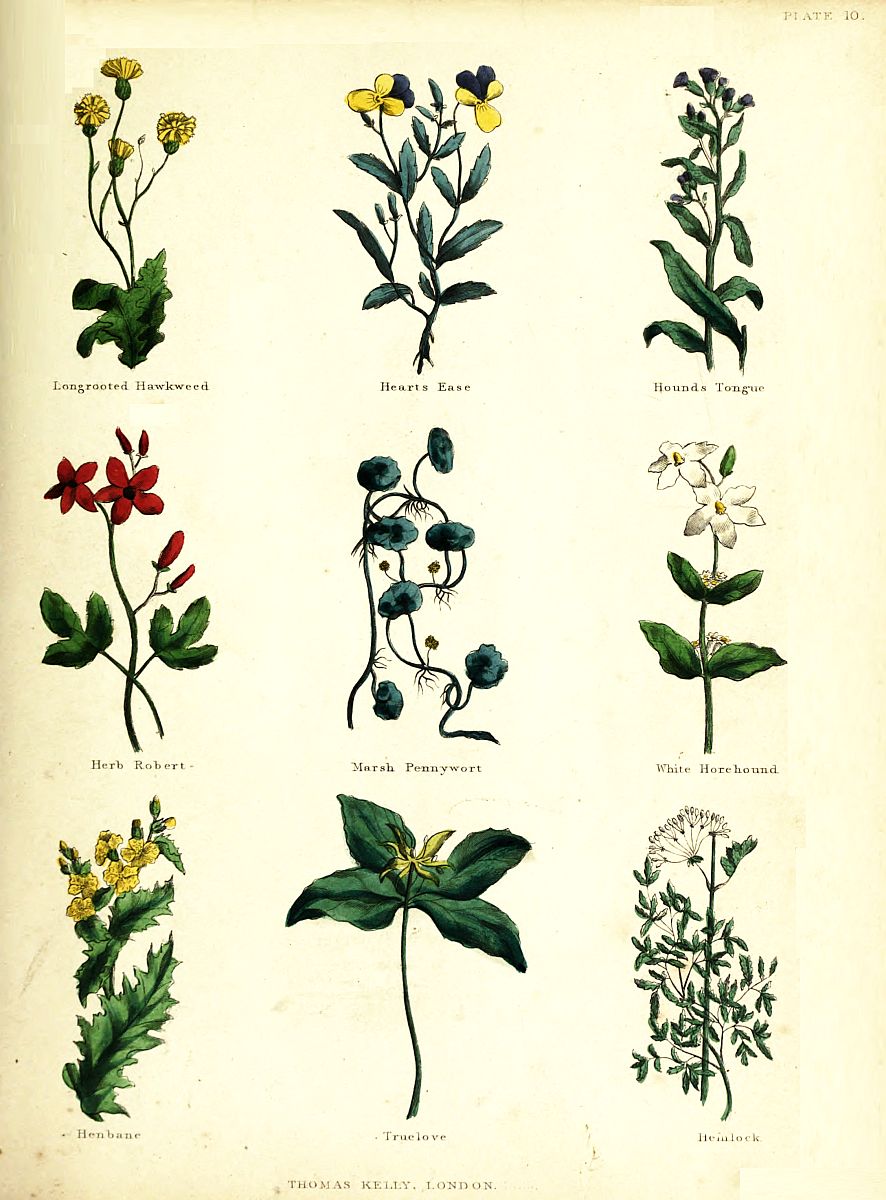
Longrooted Hawkweed, Hearts Ease, Hounds Tongue; Herb Robert, Marsh Pennywort, White Horehound; Henbane, Truelove, Hemlock
Heart’s-ease
This is that herb which such physicians as are licensed to blaspheme by authority, without danger of having their tongues burned through with an hot iron, called an herb of the Trinity. It is also called by those that are more moderate, Three Faces in a Hood, Live in Idleness, Cull me to you; and in Sussex we call them Pancies.
Place.] Besides those which are brought up in gardens, they grow commonly wild in the fields, especially in such as are very barren: sometimes you may find it on the tops of the high hills.
Time.] They flower all the Spring and Summer long.
Government and virtues.] The herb is really saturnine, something cold, viscous, and slimy. A strong decoction of the herbs and flowers (if you will, you may make it into syrup) is an excellent cure for the French pox, the herb being a gallant antivenereal: and that antivenereals are the best cure for that disease, far better and safer than to torment them with the flux, divers foreign physicians have confessed. The spirit of it is excellently good for the convulsions in children, as also for the falling sickness, and a gallant remedy for the inflammation of the lungs and breasts, pleurisy, scabs, itch, &c. It is under the celestial sign Cancer.
Artichokes
The Latins call them Cinera, only our college calls them Artichocus.
Government and virtues.] They are under the dominion of Venus, and therefore it is no marvel if they provoke lust, as indeed they do, being somewhat windy meat; and yet they stay the involuntary course of natural seed in man, which is commonly called nocturnal pollutions. And here I care not greatly if I quote a little of Galen’s nonsense in his treatise of the faculties of nourishment. He saith, they contain plenty of choleric juice, (which notwithstanding I can scarcely believe,) of which he saith is engendered melancholy juice, and of that melancholy juice thin choleric blood. But, to proceed; this is certain, that the decoction of the root boiled in wine, or the root bruised and distilled in wine in an alembic, and being drank, purges by urine exceedingly.
Hart’s-tongue
Descript.] This has divers leaves arising from the root, every one severally, which fold themselves in their first springing and spreading: when they are full grown, are about a foot long, smooth and green above, but hard and with little sap in them, and streaked on the back, athwart on both sides of the middle rib, with small and somewhat long and brownish marks; the bottoms of the leaves are a little bowed on each side of the middle rib, somewhat small at the end. The root is of many black threads, folded or interlaced together.
Time.] It is green all the Winter; but new leaves spring every year.
Government and virtues.] Jupiter claims dominion over this herb, therefore it is a singular remedy for the liver, both to strengthen it when weak, and ease it when afflicted, you shall do well to keep it in a syrup all the year; For though authors say it is green all the year, I scarcely believe it. Hart’s Tongue is much commended against the hardness and stoppings of the spleen and liver, and against the heat of the liver and stomach, and against lasks, and the bloody-flux. The distilled water thereof is also very good against the passions of the heart, and to stay the hiccough, to help the falling of the palate, and to stay the bleeding of the gums, being gargled in the mouth. Dioscorides saith, it is good against the stinging or biting of serpents. As for the use of it, my direction at the latter end will be sufficient, and enough for those that are studious in physic, to whet their brains upon for one year or two.
Hazel-nut
Hazel Nuts are so well known to every body, that they need no description.
Government and virtues.] They are under the dominion of Mercury. The parted kernels made into an electuary, or the milk drawn from the kernels with mead or honeyed water, is very good to help an old cough; and being parched, and a little pepper put to them and drank, digests the distillations of rheum from the head. The dried husks and shells, to the weight of two drams, taken in red wine, stays lasks and women’s courses, and so doth the red skin that covers the kernels, which is more effectual to stay women’s courses.
And if this be true, as it is, then why should the vulgar so familiarly affirm, that eating nuts causes shortness of breath, than which nothing is falser? For, how can that which strengthens the lungs, cause shortness of breath? I confess, the opinion is far older than I am; I knew tradition was a friend to error before, but never that he was the father of slander; Or are men’s tongues so given to slander one another, that they must slander Nuts too, to keep their tongues in use? If any part of the Hazel Nut be stopping, it is the husks and shells, and no one is so mad as to eat them unless physically; and the red skin which covers the kernel, you may easily pull off And so thus have I made an apology for Nuts, which cannot speak for themselves.
Hawk-weed
There are several sorts of Hawk-weed, but they are similar in virtues.
Descript.] It has many large leaves lying upon the ground, much rent or torn on the sides into gashes like Dandelion, but with greater parts, more like the smooth Sow Thistle, from among which rises a hollow, rough stalk, two or three feet high, branched from the middle upward, whereon are set at every joint longer leaves, little or nothing rent or cut, bearing on them sundry pale, yellow flowers, consisting of many small, narrow leaves, broad pointed, and nicked in at the ends, set in a double row or more, the outermost being larger than the inner, which form most of the Hawk-weeds (for there are many kinds of them) do hold, which turn into down, and with the small brownish seed is blown away with the wind. The root is long and somewhat great, with many small fibres thereat. The whole plant is full of bitter-milk.
Place.] It grows in divers places about the field sides, and the path-ways in dry grounds.
Time.] It flowers and flies away in the Summer months.
Government and virtues.] Saturn owns it. Hawk-weed (saith Dioscorides) is cooling, somewhat drying and binding, and therefore good for the heat of the stomach, and gnawings therein; for inflammations and the hot fits of agues. The juice thereof in wine, helps digestion, discusses wind, hinders crudities abiding in the stomach, and helps the difficulty of making water, the biting of venomous serpents, and stinging of the scorpion, if the herb be also outwardly applied to the place, and is very good against all other poisons. A scruple of the dried root given in wine and vinegar, is profitable for those that have the dropsy. The decoction of the herb taken in honey, digests the phlegm in the chest or lungs, and with Hyssop helps the cough. The decoction thereof, and of wild Succory, made with wine, and taken, helps the wind cholic and hardness of the spleen; it procures rest and sleep, hinders venery and venerous dreams, cooling heats, purges the stomach, increases blood, and helps the diseases of the reins and bladder. Outwardly applied, it is singularly good for all the defects and diseases of the eyes, used with some women’s milk; and used with good success in fretting or creeping ulcers, especially in the beginning. The green leaves bruised, and with a little salt applied to any place burnt with fire, before blisters do rise, helps them; as also inflammations, St. Anthony’s fire, and all pushes and eruptions, hot and salt phlegm. The same applied with meal and fair water in manner of a poultice, to any place affected with convulsions, the cramp, and such as are out of joint, doth give help and ease. The distilled water cleanses the skin, and takes away freckles, spots, morphew, or wrinkles in the face.
Hawthorn
It is not my intention to trouble you with a description of this tree, which is so well known that it needs none. It is ordinarily but a hedge bush, although being pruned and dressed, it grows to a tree of a reasonable height.
As for the Hawthorn Tree at Glastonbury, which is said to flower yearly on Christmas-day, it rather shews the superstition of those that observe it for the time of its flowering, than any great wonder, since the like may be found in divers other places of this land; as in Whey-street in Romney Marsh, and near unto Nantwich in Cheshire, by a place called White Green, where it flowers about Christmas and May. If the weather be frosty, it flowers not until January, or that the hard weather be over.
Government and virtues.] It is a tree of Mars. The seeds in the berries beaten to powder being drank in wine, are held singularly good against the stone, and are good for the dropsy. The distilled water of the flowers stay the lask. The seed cleared from the down, bruised and boiled in wine, and drank, is good for inward tormenting pains. If cloths or sponges be wet in the distilled water, and applied to any place wherein thorns and splinters, or the like, do abide in the flesh, it will notably draw them forth.
And thus you see the thorn gives a medicine for its own pricking, and so doth almost every thing else.
Hemlock
Descript.] The common great Hemlock grows up with a green stalk, four or five feet high, or more, full of red spots sometimes, and at the joints very large winged leaves set at them, which are divided into many other winged leaves, one set against the other, dented about the edges, of a sad green colour, branched towards the top, where it is full of umbels of white flowers, and afterwards with whitish flat seed: The root is long, white, and sometimes crooked, and hollow within. The whole plant, and every part, has a strong, heady, and ill-savoured scent, much offending the senses.
Place.] It grows in all counties of this land, by walls and hedge-sides, in waste grounds and untilled places.
Time.] It flowers and seeds in July, or thereabouts.
Government and virtues.] Saturn claims dominion over this herb, yet I wonder why it may not be applied to the privities in a Priapism, or continual standing of the yard, it being very beneficial to that disease; I suppose, my author’s judgment was first upon the opposite disposition of Saturn to Venus in those faculties, and therefore he forbade the applying of it to those parts, that it might not cause barrenness, or spoil the spirit procreative; which if it do, yet applied to the privities, it stops its lustful thoughts. Hemlock is exceedingly cold, and very dangerous, especially to be taken inwardly. It may safely be applied to inflammations, tumours, and swellings in any part of the body (save the privy parts) as also to St. Anthony’s fire, wheals, pushes, and creeping ulcers that arise of hot sharp humours, by cooling and repelling the heat; the leaves bruised and laid to the brow or forehead are good for their eyes that are red and swollen; as also to take away a pin and web growing in the eye; this is a tried medicine: Take a small handful of this herb, and half so much bay salt, beaten together, and applied to the contrary wrist of the hand, for 24 hours, doth remove it in thrice dressing. If the root thereof be roasted under the embers, wrapped in double wet paper, until it be soft and tender, and then applied to the gout in the hands or fingers, it will quickly help this evil. If any through mistake eat the herb Hemlock instead of Parsley, or the roots instead of a Parsnip (both of which it is very like) whereby happens a kind of frenzy, or perturbation of the senses, as if they were stupid and drunk, the remedy is (as Pliny saith) to drink of the best and strongest pure wine, before it strikes to the heart, or Gentian put in wine, or a draught of vinegar, wherewith Tragus doth affirm, that he cured a woman that had eaten the root.
Hemp
This is so well known to every good housewife in the country, that I shall not need to write any description of it.
Time.] It is sown in the very end of March, or beginning of April, and is ripe in August or September.
Government and virtues.] It is a plant of Saturn, and good for something else, you see, than to make halters only. The seed of Hemp consumes wind, and by too much use thereof disperses it so much that it dries up the natural seed for procreation; yet, being boiled in milk and taken, helps such as have a hot dry cough. The Dutch make an emulsion out of the seed, and give it with good success to those that have the jaundice, especially in the beginning of the disease, if there be no ague accompanying it, for it opens obstructions of the gall, and causes digestion of choler. The emulsion or decoction of the seed stays lasks and continual fluxes, eases the cholic, and allays the troublesome humours in the bowels, and stays bleeding at the mouth, nose, or other places, some of the leaves being fried with the blood of them that bleed, and so given them to eat. It is held very good to kill the worms in men or beasts; and the juice dropped into the ears kills worms in them; and draws forth earwigs, or other living creatures gotten into them. The decoction of the root allays inflammations of the head, or any other parts: the herb itself, or the distilled water thereof doth the like. The decoction of the root eases the pains of the gout, the hard humours of knots in the joints, the pains and shrinking of the sinews, and the pains of the hips. The fresh juice mixed with a little oil and butter, is good for any place that hath been burnt with fire, being thereto applied.
Henbane
Descript.] Our common Henbane has very large, thick, soft, woolly leaves, lying on the ground, much cut in, or torn on the edges, of a dark, ill greyish green colour; among which arise up divers thick and short stalks, two or three feet high, spread into divers small branches, with lesser leaves on them, and many hollow flowers, scarce appearing above the husk, and usually torn on one side, ending in five round points, growing one above another, of a deadish yellowish colour, somewhat paler towards the edges, with many purplish veins therein, and of a dark, yellowish purple in the bottom of the flower, with a small point of the same colour in the middle, each of them standing in a hard close husk, which after the flowers are past, grow very like the husk of Asarabacca, and somewhat sharp at the top points, wherein is contained much small seed, very like Poppy seed, but of a dusky, greyish colour. The root is great, white, and thick, branching forth divers ways under ground, so like a Parsnip root (but that it is not so white) that it has deceived others. The whole plant more than the root, has a very heavy, ill, soporiferous smell, somewhat offensive.
Place.] It commonly grows by the way-sides, and under hedge-sides and walls.
Time.] It flowers in July, and springs again yearly of its own seed. I doubt my authors mistook July for June, if not for May.
Government and virtues.] I wonder how astrologers could take on them to make this an herb of Jupiter; and yet Mizaldus, a man of a penetrating brain, was of that opinion as well as the rest; the herb is indeed under the dominion of Saturn, and I prove it by this argument: All the herbs which delight most to grow in saturnine places, are saturnine herbs. Both Henbane delights most to grow in saturnine places, and whole cart loads of it may be found near the places where they empty the common Jakes, and scarce a ditch to be found without it growing by it. Ergo, it is an herb of Saturn. The leaves of Henbane do cool all hot inflammations in the eyes, or any other part of the body; and are good to assuage all manner of swellings of the privities, or women’s breast, or elsewhere, if they be boiled in wine, and either applied themselves, or the fomentation warm; it also assuages the pain of the gout, the sciatica, and other pains in the joints which arise from a hot cause. And applied with vinegar to the forehead and temples, helps the head-ache and want of sleep in hot fevers. The juice of the herb or seed, or the oil drawn from the seed, does the like. The oil of the seed is helpful for deafness, noise, and worms in the ears, being dropped therein; the juice of the herb or root doth the same. The decoction of the herb or seed, or both, kills lice in man or beast. The fume of the dried herb, stalks and seed, burned, quickly heals swellings, chilblains or kibes in the hands or feet, by holding them in the fume thereof. The remedy to help those that have taken Henbane is to drink goat’s milk, honeyed water, or pine kernels, with sweet wine; or, in the absence of these, Fennel seed, Nettle seed, the seed of Cresses, Mustard, or Radish; as also Onions or Garlic taken in wine, do all help to free them from danger, and restore them to their due temper again.
Take notice, that this herb must never be taken inwardly; outwardly, an oil ointment, or plaister of it, is most admirable for the gout, to cool the veneral heat of the reins in the French pox; to stop the toothache, being applied to the aching side: to allay all inflammations, and to help the diseases before premised.
Hedge Hyssop
Divers sorts there are of this plant; the first of which is an Italian by birth, and only nursed up here in the gardens of the curious. Two or three sorts are found commonly growing wild here, the description of two of which I shall give you.
Descript.] The first is a smooth, low plant, not a foot high, very bitter in taste, with many square stalks, diversly branched from the bottom to the top, with divers joints, and two small leaves at each joint, broader at the bottom than they are at the end, a little dented about the edges, of a sad green colour, and full of veins. The flowers stand at the joints, being of a fair purple colour, with some white spots in them, in fashion like those of dead nettles. The seed is small and yellow, and the roots spread much under ground.
The second seldom grows half a foot high, sending up many small branches, whereon grow many small leaves, set one against the other, somewhat broad, but very short. The flowers are like the flowers of the other fashion, but of a pale reddish colour. The seeds are small and yellowish. The root spreads like the other, neither will it yield to its fellow one ace of bitterness.
Place.] They grow in wet low grounds, and by the water-sides; the last may be found among the bogs on Hampstead Heath.
Time.] They flower in June or July, and the seed is ripe presently after.
Government and virtues.] They are herbs of Mars, and as choleric and churlish as he is, being most violent purges, especially of choler and phlegm. It is not safe taking them inwardly, unless they be well rectified by the art of the alchymist, and only the purity of them given; so used they may be very helpful both for the dropsy, gout, and sciatica; outwardly used in ointments they kill worms, the belly anointed with it, and are excellently good to cleanse old and filthy ulcers.
Black Hellebore
It is also called Setter-wort, Setter-grass, Bear’s-foot, Christmas-herb, and Christmas-flowers.
Descript.] It hath sundry fair green leaves rising from the root, each of them standing about an handful high from the earth; each leaf is divided into seven, eight, or nine parts, dented from the middle of the leaf to the point on both sides, abiding green all the Winter; about Christmas-time, if the weather be any thing temperate, the flowers appear upon foot stalks, also consisting of five large, round, white leaves a-piece, which sometimes are purple towards the edges, with many pale yellow thumbs in the middle; the seeds are divided into several cells, like those of Columbines, save only that they are greater; the seeds are in colour black, and in form long and round. The root consists of numberless blackish strings all united into one head. There is another Black Hellebore, which grows up and down in the woods very like this, but only that the leaves are smaller and narrower, and perish in the Winter, which this doth not.
Place.] The first is maintained in gardens. The second is commonly found in the woods in Northamptonshire.
Time.] The first flowers in December or January; the second in February or March.
Government and virtues.] It is an herb of Saturn, and therefore no marvel if it has some sullen conditions with it, and would be far safer, being purified by the art of the alchymist than given raw. If any have taken any harm by taking it, the common cure is to take goat’s milk: If you cannot get goat’s milk, you must make a shift with such as you can get. The roots are very effectual against all melancholy diseases, especially such as are of long standing, as quartan agues and madness; it helps the falling sickness, the leprosy, both the yellow and black jaundice, the gout, sciatica, and convulsions; and this was found out by experience, that the root of that which grows wild in our country, works not so churlishly as those do which are brought from beyond sea, as being maintained by a more temperate air. The root used as a pessary, provokes the terms exceedingly; also being beaten into powder, and strewed upon foul ulcers, it consumes the dead flesh, and instantly heals them; nay, it will help gangrenes in the beginning. Twenty grains taken inwardly is a sufficient dose for one time, and let that be corrected with half so much cinnamon; country people used to rowel their cattle with it. If a beast be troubled with a cough, or have taken any poison, they bore a hole through the ear, and put a piece of the root in it, this will help him in 24 hours time. Many other uses farriers put it to which I shall forbear.
Herb Robert
The Herb Robert is held in great estimation by farmers, who use it in diseases of their cattle.
Descript.] It rises up with a reddish stalk two feet high, having divers leaves thereon, upon very long and reddish foot-stalks, divided at the ends into three or five divisions, each of them cut in on the edges, which sometimes turn reddish. At the tops of the stalks come forth divers flowers made of five leaves, much larger than the Dove’s-foot, and of a more reddish colour; after which come black heads, as in others. The root is small and thready, and smells, as the whole plant, very strong, almost stinking.
Place.] This grows frequently every where by the way-sides, upon ditch banks and waste grounds wheresoever one goes.
Time.] It flowers in June and July chiefly, and the seed is ripe shortly after.
Government and virtues.] It is under the dominion of Venus. Herb Robert is commended not only against the stone, but to stay blood, where or howsoever flowing, it speedily heals all green wounds, and is effectual in old ulcers in the privy parts, or elsewhere. You may persuade yourself this is true, and also conceive a good reason for it, do but consider it is an herb of Venus, for all it hath a man’s name.
Herb True-love, or One-berry
Descript.] Ordinary Herb True-love has a small creeping root running under the uppermost crust of the ground, somewhat like couch grass root, but not so white, shooting forth stalks with leaves, some whereof carry no berries, the others do; every stalk smooth without joints, and blackish green, rising about half a foot high, if it bear berries, otherwise seldom so high, bearing at the top four leaves set directly one against another, in manner of a cross or ribband tied (as it is called in a true-loves knot,) which are each of them apart somewhat like unto a night-shade leaf, but somewhat broader, having sometimes three leaves, sometimes five, sometimes six, and those sometimes greater than in others, in the middle of the four leaves rise up one small slender stalk, about an inch high, bearing at the tops thereof one flower spread open like a star, consisting of four small and long narrow pointed leaves of a yellowish green colour, and four others lying between them lesser than they; in the middle whereof stands a round dark purplish button or head, compassed about with eight small yellow mealy threads with three colours, making it the more conspicuous, and lovely to behold. This button or head in the middle, when the other leaves are withered, becomes a blackish purple berry, full of juice, of the bigness of a reasonable grape, having within it many white seeds. The whole plant is without any manifest taste.
Place.] It grows in woods and copses, and sometimes in the corners or borders of fields, and waste grounds in very many places of this land, and abundantly in the woods, copses, and other places about Chislehurst and Maidstone in Kent.
Time.] They spring up in the middle of April or May, and are in flower soon after. The berries are ripe in the end of May, and in some places in June.
Government and virtues.] Venus owns it; the leaves or berries hereof are effectual to expel poison of all sorts, especially that of the aconites; as also, the plague, and other pestilential disorders; Matthiolus saith, that some that have lain long in a lingering sickness, and others that by witchcraft (as it was thought) were become half foolish, by taking a dram of the seeds or berries hereof in powder every day for 20 days together, were restored to their former health. The roots in powder taken in wine eases the pains of the cholic speedily. The leaves are very effectual as well for green wounds, as to cleanse and heal up filthy old sores and ulcers; and is very powerful to discuss all tumours and swellings in the privy parts, the groin, or in any part of the body, and speedily to allay all inflammations. The juice of the leaves applied to felons, or those nails of the hands or toes that have imposthumes or sores gathered together at the roots of them, heals them in a short space. The herb is not to be described for the premises, but is fit to be nourished in every good woman’s garden.
Hyssop
Hyssop is so well known to be an inhabitant in every garden, that it will save me labour in writing a description thereof. The virtues are as follow.
Government and virtues.] The herb is Jupiter’s, and the sign Cancer. It strengthens all the parts of the body under Cancer and Jupiter; which what they may be, is found amply described in my astrological judgment of diseases. Dioscorides saith, that Hyssop boiled with rue and honey, and drank, helps those that are troubled with coughs, shortness of breath, wheezing and rheumatic distillation upon the lungs; taken also with oxymel, it purges gross humours by stool; and with honey, kills worms in the belly; and with fresh and new figs bruised, helps to loosen the belly, and more forcibly if the root of Flower-de-luce and cresses be added thereto. It amends and cherishes the native colour of the body, spoiled by the yellow jaundice; and being taken with figs and nitre, helps the dropsy and spleen; being boiled with wine, it is good to wash inflammations, and takes away the black and blue spots and marks that come by strokes, bruises, or falls, being applied with warm water. It is an excellent medicine for the quinsy, or swellings in the throat, to wash and gargle it, being boiled in figs; it helps the tooth-ache, being boiled in vinegar and gargled therewith. The hot vapours of the decoction taken by a funnel in at the ears, eases the inflammations and singing noise of them. Being bruised, and salt, honey, and cummin seed put to it, helps those that are stung by serpents. The oil thereof (the head being anointed) kills lice, and takes away itching of the head. It helps those that have the falling sickness, which way soever it be applied. It helps to expectorate tough phlegm, and is effectual in all cold griefs or diseases of the chests or lungs, being taken either in syrup or licking medicine. The green herb bruised and a little sugar put thereto, doth quickly heal any cut or green wounds, being thereunto applied.
Hops
These are so well known that they need no description; I mean the manured kind, which every good husband or housewife is acquainted with.
Descript.] The wild hop grows up as the other doth, ramping upon trees or hedges, that stand next to them, with rough branches and leaves like the former, but it gives smaller heads, and in far less plenty than it, so that there is scarcely a head or two seen in a year on divers of this wild kind, wherein consists the chief difference.
Place.] They delight to grow in low moist grounds, and are found in all parts of this land.
Time.] They spring not until April, and flower not until the latter end of June; the heads are not gathered until the middle or latter end of September.
Government and virtues.] It is under the dominion of Mars. This, in physical operations, is to open obstructions of the liver and spleen, to cleanse the blood, to loosen the belly, to cleanse the reins from gravel, and provoke urine. The decoction of the tops of Hops, as well of the tame as the wild, works the same effects. In cleansing the blood they help to cure the French diseases, and all manner of scabs, itch, and other breakings-out of the body; as also all tetters, ringworms, and spreading sores, the morphew and all discolouring of the skin. The decoction of the flowers and hops, do help to expel poison that any one hath drank. Half a dram of the seed in powder taken in drink, kills worms in the body, brings down women’s courses, and expels urine. A syrup made of the juice and sugar, cures the yellow jaundice, eases the head-ache that comes of heat, and tempers the heat of the liver and stomach, and is profitably given in long and hot agues that rise in choler and blood. Both the wild and the manured are of one property, and alike effectual in all the aforesaid diseases. By all these testimonies beer appears to be better than ale.
Mars owns the plant, and then Dr. Reason will tell you how it performs these actions.
Horehound
There are two kinds of Horehound, the white and the black. The black sort is likewise called Hen-bit; but the white one is here spoken of.
Descript.] Common Horehound grows up with square hairy stalks, half a yard or two feet high, set at the joints with two round crumpled rough leaves of a sullen hoary green colour, of a reasonable good scent, but a very bitter taste. The flowers are small, white, and gaping, set in a rough, hard prickly husk round about the joints, with the leaves from the middle of the stalk upward, wherein afterward is found small round blackish seed. The root is blackish, hard and woody, with many strings, and abides many years.
Place.] It is found in many parts of this land, in dry grounds, and waste green places.
Time.] It flowers in July, and the seed is ripe in August.
Government and virtues.] It is an herb of Mercury. A decoction of the dried herb, with the seed, or the juice of the green herb taken with honey, is a remedy for those that are short-winded, have a cough, or are fallen into a consumption, either through long sickness, or thin distillations of rheum upon the lungs. It helps to expectorate tough phlegm from the chest, being taken from the roots of Iris or Orris. It is given to women to bring down their courses, to expel the after-birth, and to them that have taken poison, or are stung or bitten by venemous serpents. The leaves used with honey, purge foul ulcers, stay running or creeping sores, and the growing of the flesh over the nails. It also helps pains of the sides. The juice thereof with wine and honey, helps to clear the eyesight, and snuffed up into the nostrils, purges away the yellow-jaundice, and with a little oil of roses dropped into the ears, eases the pains of them. Galen saith, it opens obstructions both of the liver and spleen, and purges the breast and lungs of phlegm: and used outwardly it both cleanses and digests. A decoction of Horehound (saith Matthiolus) is available for those that have hard livers, and for such as have itches and running tetters. The powder hereof taken, or the decoction, kills worms. The green leaves bruised, and boiled in old hog’s grease into an ointment, heals the biting of dogs, abates the swellings and pains that come by any pricking of thorns, or such like means; and used with vinegar, cleanses and heals tetters. There is a syrup made of Horehound to be had at the apothecaries, very good for old coughs, to rid the tough phlegm; as also to void cold rheums from the lungs of old folks, and for those that are asthmatic or short-winded.
Horsetail
Of that there are many kinds, but I shall not trouble you nor myself with any large description of them, which to do, were but, as the proverb is, To find a knot in a rush, all the kinds thereof being nothing else but knotted rushes, some with leaves, and some without. Take the description of the most eminent sort as follows.
Descript.] The great Horsetail at the first springing has heads somewhat like those of asparagus, and afterwards grow to be hard, rough, hollow stalks, jointed at sundry places up to the top, a foot high, so made as if the lower parts were put into the upper, where grow on each side a bush of small long rush-like hard leaves, each part resembling a horsetail, from whence it is so called. At the tops of the stalks come forth small catkins, like those of trees. The root creeps under ground, having joints at sundry places.
Place.] This (as most of the other sorts hereof) grows in wet grounds.
Time.] They spring up in April, and their blooming catkins in July, seeding for the most part in August, and then perish down to the ground, rising afresh in the Spring.
Government and virtues.] The herb belongs to Saturn, yet is very harmless, and excellently good for the things following: Horsetail, the smoother rather than the rough, and the leaves rather than the bare, is most physical. It is very powerful to staunch bleeding either inward or outward, the juice or the decoction thereof being drank, or the juice, decoction, or distilled water applied outwardly. It also stays all sorts of lasks and fluxes in man or woman, and bloody urine; and heals also not only the inward ulcers, and the excoriation of the entrails, bladder, &c. but all other sorts of foul, moist and running ulcers, and soon solders together the tops of green wounds. It cures all ruptures in children. The decoction thereof in wine being drank, provokes urine, and helps the stone and stranguary; and the distilled water thereof drank two or three times in a day, and a small quantity at a time, also eases the bowels, and is effectual against a cough that comes by distillations from the head. The juice or distilled water being warmed, and hot inflammations, pustules or red wheals, and other breakings-out in the skin, being bathed therewith, doth help them, and doth no less the swelling heat and inflammation of the lower parts in men and women.
Houseleek or Sengreen
Both these are so well known to my countrymen, that I shall not need to write any description of them.
Place.] It grows commonly upon walls and house-sides, and flowers in July.
Government and virtues.] It is an herb of Jupiter, and it is reported by Mezaldus, to preserve what it grows upon from fire and lightning. Our ordinary Houseleek is good for all inward heats as well as outward, and in the eyes or other parts of the body; a posset made with the juice of Houseleek, is singularly good in all hot agues, for it cools and tempers the blood and spirits, and quenches the thirst; and also good to stay all hot defluctions or sharp and salt rheums in the eyes, the juice being dropped into them, or into the ears. It helps also other fluxes of humours in the bowels, and the immoderate courses of women. It cools and restrains all other hot inflammations, St. Anthony’s fire, scaldings and burnings, the shingles, fretting ulcers, cankers, tettors, ringworms, and the like; and much eases the pains of the gout proceeding from any hot cause. The juice also takes away worts and corns in the hands or feet, being often bathed therewith, and the skin and leaves being laid on them afterwards. It eases also the head-ache, and distempered heat of the brain in frenzies, or through want of sleep, being applied to the temples and forehead. The leaves bruised and laid upon the crown or seam of the head, stays bleeding at the nose very quickly. The distilled water of the herb is profitable for all the purposes aforesaid. The leaves being gently rubbed on any place stung with nettles or bees, doth quickly take away the pain.
Hound’s Tongue
Descript.] The great ordinary Hound’s Tongue has many long and somewhat narrow, soft, hairy, darkish green leaves, lying on the ground, somewhat like unto Bugloss leaves, from among which rises up a rough hairy stalk about two feet high, with some smaller leaves thereon, and branched at the tops into divers parts, with a small leaf at the foot of every branch, which is somewhat long, with many flowers set along the same, which branch is crooked or turned inwards before it flowers, and opens by degrees as the flowers blow, which consist of small purplish red leaves of a dead colour, rising out of the husks wherein they stand with some threads in the middle. It has sometimes a white flower. After the flowers are past, there comes rough flat seed, with a small pointle in the middle, easily cleaving to any garment that it touches, and not so easily pulled off again. The root is black, thick, and long, hard to break, and full of clammy juice, smelling somewhat strong, of an evil scent, as the leaves also do.
Place.] It grows in moist places of this land, in waste grounds, and untilled places, by highway sides, lanes, and hedge-sides.
Time.] It flowers about May or June, and the seed is ripe shortly after.
Government and virtues.] It is a plant under the dominion of Mercury. The root is very effectually used in pills, as well as the decoction, or otherwise, to stay all sharp and thin defluxions of rheum from the head into the eyes or nose, or upon the stomach or lungs, as also for coughs and shortness of breath. The leaves boiled in wine (saith Dioscorides, but others do rather appoint it to be made with water, and add thereto oil and salt) molifies or opens the belly downwards. It also helps to cure the biting of a mad dog, some of the leaves being also applied to the wound: The leaves bruised, or the juice of them boiled in hog’s lard, and applied, helps falling away of the hair, which comes of hot and sharp humours; as also for any place that is scalded or burnt; the leaves bruised and laid to any green wound doth heal it up quickly: the root baked under the embers, wrapped in paste or wet paper, or in a wet double cloth, and thereof a suppository made, and put up into or applied to the fundament, doth very effectually help the painful piles or hæmorrhoids. The distilled water of the herbs and roots is very good to all the purposes aforesaid, to be used as well inwardly to drink, as outwardly to wash any sore place, for it heals all manner of wounds and punctures, and those foul ulcers that arise by the French pox. Mizaldus adds that the leaves laid under the feet, will keep the dogs from barking at you. It is called Hound’s-tongue, because it ties the tongues of hounds; whether true, or not, I never tried, yet I cured the biting of a mad dog with this only medicine.
Holly, Holm, or Hulver Bush
For to describe a tree so well known is needless.
Government and virtues.] The tree is Saturnine. The berries expel wind, and therefore are held to be profitable in the cholic. The berries have a strong faculty with them; for if you eat a dozen of them in the morning fasting when they are ripe and not dried, they purge the body of gross and clammy phlegm: but if you dry the berries, and beat them into powder, they bind the body, and stop fluxes, bloody-fluxes, and the terms in women. The bark of the tree, and also the leaves, are excellently good, being used in fomentations for broken bones, and such members as are out of joint. Pliny saith, the branches of the tree defend houses from lightning, and men from witchcraft.
The end of H: Heart’s-ease to Holly.
Turn the page for St. John’s Wort to Juniper Bush.
Tap or click the right-hand side of the book to turn the page, the left to turn back; or use the arrow keys, or swipe. Press F for full screen.
The English Physician Enlarged · H
Heart’s-ease to Holly
Longrooted Hawkweed, Hearts Ease, Hounds Tongue; Herb Robert, Marsh Pennywort, White Horehound; Henbane, Truelove, Hemlock
Heart’s-ease
This is that herb which such physicians as are licensed to blaspheme by authority, without danger of having their tongues burned through with an hot iron, called an herb of the Trinity. It is also called by those that are more moderate, Three Faces in a Hood, Live in Idleness, Cull me to you; and in Sussex we call them Pancies.
Place.] Besides those which are brought up in gardens, they grow commonly wild in the fields, especially in such as are very barren: sometimes you may find it on the tops of the high hills.
Time.] They flower all the Spring and Summer long.
Government and virtues.] The herb is really saturnine, something cold, viscous, and slimy. A strong decoction of the herbs and flowers (if you will, you may make it into syrup) is an excellent cure for the French pox, the herb being a gallant antivenereal: and that antivenereals are the best cure for that disease, far better and safer than to torment them with the flux, divers foreign physicians have confessed. The spirit of it is excellently good for the convulsions in children, as also for the falling sickness, and a gallant remedy for the inflammation of the lungs and breasts, pleurisy, scabs, itch, &c. It is under the celestial sign Cancer.
Artichokes
The Latins call them Cinera, only our college calls them Artichocus.
Government and virtues.] They are under the dominion of Venus, and therefore it is no marvel if they provoke lust, as indeed they do, being somewhat windy meat; and yet they stay the involuntary course of natural seed in man, which is commonly called nocturnal pollutions. And here I care not greatly if I quote a little of Galen’s nonsense in his treatise of the faculties of nourishment. He saith, they contain plenty of choleric juice, (which notwithstanding I can scarcely believe,) of which he saith is engendered melancholy juice, and of that melancholy juice thin choleric blood. But, to proceed; this is certain, that the decoction of the root boiled in wine, or the root bruised and distilled in wine in an alembic, and being drank, purges by urine exceedingly.
Hart’s-tongue
Descript.] This has divers leaves arising from the root, every one severally, which fold themselves in their first springing and spreading: when they are full grown, are about a foot long, smooth and green above, but hard and with little sap in them, and streaked on the back, athwart on both sides of the middle rib, with small and somewhat long and brownish marks; the bottoms of the leaves are a little bowed on each side of the middle rib, somewhat small at the end. The root is of many black threads, folded or interlaced together.
Time.] It is green all the Winter; but new leaves spring every year.
Government and virtues.] Jupiter claims dominion over this herb, therefore it is a singular remedy for the liver, both to strengthen it when weak, and ease it when afflicted, you shall do well to keep it in a syrup all the year; For though authors say it is green all the year, I scarcely believe it. Hart’s Tongue is much commended against the hardness and stoppings of the spleen and liver, and against the heat of the liver and stomach, and against lasks, and the bloody-flux. The distilled water thereof is also very good against the passions of the heart, and to stay the hiccough, to help the falling of the palate, and to stay the bleeding of the gums, being gargled in the mouth. Dioscorides saith, it is good against the stinging or biting of serpents. As for the use of it, my direction at the latter end will be sufficient, and enough for those that are studious in physic, to whet their brains upon for one year or two.
Hazel-nut
Hazel Nuts are so well known to every body, that they need no description.
Government and virtues.] They are under the dominion of Mercury. The parted kernels made into an electuary, or the milk drawn from the kernels with mead or honeyed water, is very good to help an old cough; and being parched, and a little pepper put to them and drank, digests the distillations of rheum from the head. The dried husks and shells, to the weight of two drams, taken in red wine, stays lasks and women’s courses, and so doth the red skin that covers the kernels, which is more effectual to stay women’s courses.
And if this be true, as it is, then why should the vulgar so familiarly affirm, that eating nuts causes shortness of breath, than which nothing is falser? For, how can that which strengthens the lungs, cause shortness of breath? I confess, the opinion is far older than I am; I knew tradition was a friend to error before, but never that he was the father of slander; Or are men’s tongues so given to slander one another, that they must slander Nuts too, to keep their tongues in use? If any part of the Hazel Nut be stopping, it is the husks and shells, and no one is so mad as to eat them unless physically; and the red skin which covers the kernel, you may easily pull off And so thus have I made an apology for Nuts, which cannot speak for themselves.
Hawk-weed
There are several sorts of Hawk-weed, but they are similar in virtues.
Descript.] It has many large leaves lying upon the ground, much rent or torn on the sides into gashes like Dandelion, but with greater parts, more like the smooth Sow Thistle, from among which rises a hollow, rough stalk, two or three feet high, branched from the middle upward, whereon are set at every joint longer leaves, little or nothing rent or cut, bearing on them sundry pale, yellow flowers, consisting of many small, narrow leaves, broad pointed, and nicked in at the ends, set in a double row or more, the outermost being larger than the inner, which form most of the Hawk-weeds (for there are many kinds of them) do hold, which turn into down, and with the small brownish seed is blown away with the wind. The root is long and somewhat great, with many small fibres thereat. The whole plant is full of bitter-milk.
Place.] It grows in divers places about the field sides, and the path-ways in dry grounds.
Time.] It flowers and flies away in the Summer months.
Government and virtues.] Saturn owns it. Hawk-weed (saith Dioscorides) is cooling, somewhat drying and binding, and therefore good for the heat of the stomach, and gnawings therein; for inflammations and the hot fits of agues. The juice thereof in wine, helps digestion, discusses wind, hinders crudities abiding in the stomach, and helps the difficulty of making water, the biting of venomous serpents, and stinging of the scorpion, if the herb be also outwardly applied to the place, and is very good against all other poisons. A scruple of the dried root given in wine and vinegar, is profitable for those that have the dropsy. The decoction of the herb taken in honey, digests the phlegm in the chest or lungs, and with Hyssop helps the cough. The decoction thereof, and of wild Succory, made with wine, and taken, helps the wind cholic and hardness of the spleen; it procures rest and sleep, hinders venery and venerous dreams, cooling heats, purges the stomach, increases blood, and helps the diseases of the reins and bladder. Outwardly applied, it is singularly good for all the defects and diseases of the eyes, used with some women’s milk; and used with good success in fretting or creeping ulcers, especially in the beginning. The green leaves bruised, and with a little salt applied to any place burnt with fire, before blisters do rise, helps them; as also inflammations, St. Anthony’s fire, and all pushes and eruptions, hot and salt phlegm. The same applied with meal and fair water in manner of a poultice, to any place affected with convulsions, the cramp, and such as are out of joint, doth give help and ease. The distilled water cleanses the skin, and takes away freckles, spots, morphew, or wrinkles in the face.
Hawthorn
It is not my intention to trouble you with a description of this tree, which is so well known that it needs none. It is ordinarily but a hedge bush, although being pruned and dressed, it grows to a tree of a reasonable height.
As for the Hawthorn Tree at Glastonbury, which is said to flower yearly on Christmas-day, it rather shews the superstition of those that observe it for the time of its flowering, than any great wonder, since the like may be found in divers other places of this land; as in Whey-street in Romney Marsh, and near unto Nantwich in Cheshire, by a place called White Green, where it flowers about Christmas and May. If the weather be frosty, it flowers not until January, or that the hard weather be over.
Government and virtues.] It is a tree of Mars. The seeds in the berries beaten to powder being drank in wine, are held singularly good against the stone, and are good for the dropsy. The distilled water of the flowers stay the lask. The seed cleared from the down, bruised and boiled in wine, and drank, is good for inward tormenting pains. If cloths or sponges be wet in the distilled water, and applied to any place wherein thorns and splinters, or the like, do abide in the flesh, it will notably draw them forth.
And thus you see the thorn gives a medicine for its own pricking, and so doth almost every thing else.
Hemlock
Descript.] The common great Hemlock grows up with a green stalk, four or five feet high, or more, full of red spots sometimes, and at the joints very large winged leaves set at them, which are divided into many other winged leaves, one set against the other, dented about the edges, of a sad green colour, branched towards the top, where it is full of umbels of white flowers, and afterwards with whitish flat seed: The root is long, white, and sometimes crooked, and hollow within. The whole plant, and every part, has a strong, heady, and ill-savoured scent, much offending the senses.
Place.] It grows in all counties of this land, by walls and hedge-sides, in waste grounds and untilled places.
Time.] It flowers and seeds in July, or thereabouts.
Government and virtues.] Saturn claims dominion over this herb, yet I wonder why it may not be applied to the privities in a Priapism, or continual standing of the yard, it being very beneficial to that disease; I suppose, my author’s judgment was first upon the opposite disposition of Saturn to Venus in those faculties, and therefore he forbade the applying of it to those parts, that it might not cause barrenness, or spoil the spirit procreative; which if it do, yet applied to the privities, it stops its lustful thoughts. Hemlock is exceedingly cold, and very dangerous, especially to be taken inwardly. It may safely be applied to inflammations, tumours, and swellings in any part of the body (save the privy parts) as also to St. Anthony’s fire, wheals, pushes, and creeping ulcers that arise of hot sharp humours, by cooling and repelling the heat; the leaves bruised and laid to the brow or forehead are good for their eyes that are red and swollen; as also to take away a pin and web growing in the eye; this is a tried medicine: Take a small handful of this herb, and half so much bay salt, beaten together, and applied to the contrary wrist of the hand, for 24 hours, doth remove it in thrice dressing. If the root thereof be roasted under the embers, wrapped in double wet paper, until it be soft and tender, and then applied to the gout in the hands or fingers, it will quickly help this evil. If any through mistake eat the herb Hemlock instead of Parsley, or the roots instead of a Parsnip (both of which it is very like) whereby happens a kind of frenzy, or perturbation of the senses, as if they were stupid and drunk, the remedy is (as Pliny saith) to drink of the best and strongest pure wine, before it strikes to the heart, or Gentian put in wine, or a draught of vinegar, wherewith Tragus doth affirm, that he cured a woman that had eaten the root.
Hemp
This is so well known to every good housewife in the country, that I shall not need to write any description of it.
Time.] It is sown in the very end of March, or beginning of April, and is ripe in August or September.
Government and virtues.] It is a plant of Saturn, and good for something else, you see, than to make halters only. The seed of Hemp consumes wind, and by too much use thereof disperses it so much that it dries up the natural seed for procreation; yet, being boiled in milk and taken, helps such as have a hot dry cough. The Dutch make an emulsion out of the seed, and give it with good success to those that have the jaundice, especially in the beginning of the disease, if there be no ague accompanying it, for it opens obstructions of the gall, and causes digestion of choler. The emulsion or decoction of the seed stays lasks and continual fluxes, eases the cholic, and allays the troublesome humours in the bowels, and stays bleeding at the mouth, nose, or other places, some of the leaves being fried with the blood of them that bleed, and so given them to eat. It is held very good to kill the worms in men or beasts; and the juice dropped into the ears kills worms in them; and draws forth earwigs, or other living creatures gotten into them. The decoction of the root allays inflammations of the head, or any other parts: the herb itself, or the distilled water thereof doth the like. The decoction of the root eases the pains of the gout, the hard humours of knots in the joints, the pains and shrinking of the sinews, and the pains of the hips. The fresh juice mixed with a little oil and butter, is good for any place that hath been burnt with fire, being thereto applied.
Henbane
Descript.] Our common Henbane has very large, thick, soft, woolly leaves, lying on the ground, much cut in, or torn on the edges, of a dark, ill greyish green colour; among which arise up divers thick and short stalks, two or three feet high, spread into divers small branches, with lesser leaves on them, and many hollow flowers, scarce appearing above the husk, and usually torn on one side, ending in five round points, growing one above another, of a deadish yellowish colour, somewhat paler towards the edges, with many purplish veins therein, and of a dark, yellowish purple in the bottom of the flower, with a small point of the same colour in the middle, each of them standing in a hard close husk, which after the flowers are past, grow very like the husk of Asarabacca, and somewhat sharp at the top points, wherein is contained much small seed, very like Poppy seed, but of a dusky, greyish colour. The root is great, white, and thick, branching forth divers ways under ground, so like a Parsnip root (but that it is not so white) that it has deceived others. The whole plant more than the root, has a very heavy, ill, soporiferous smell, somewhat offensive.
Place.] It commonly grows by the way-sides, and under hedge-sides and walls.
Time.] It flowers in July, and springs again yearly of its own seed. I doubt my authors mistook July for June, if not for May.
Government and virtues.] I wonder how astrologers could take on them to make this an herb of Jupiter; and yet Mizaldus, a man of a penetrating brain, was of that opinion as well as the rest; the herb is indeed under the dominion of Saturn, and I prove it by this argument: All the herbs which delight most to grow in saturnine places, are saturnine herbs. Both Henbane delights most to grow in saturnine places, and whole cart loads of it may be found near the places where they empty the common Jakes, and scarce a ditch to be found without it growing by it. Ergo, it is an herb of Saturn. The leaves of Henbane do cool all hot inflammations in the eyes, or any other part of the body; and are good to assuage all manner of swellings of the privities, or women’s breast, or elsewhere, if they be boiled in wine, and either applied themselves, or the fomentation warm; it also assuages the pain of the gout, the sciatica, and other pains in the joints which arise from a hot cause. And applied with vinegar to the forehead and temples, helps the head-ache and want of sleep in hot fevers. The juice of the herb or seed, or the oil drawn from the seed, does the like. The oil of the seed is helpful for deafness, noise, and worms in the ears, being dropped therein; the juice of the herb or root doth the same. The decoction of the herb or seed, or both, kills lice in man or beast. The fume of the dried herb, stalks and seed, burned, quickly heals swellings, chilblains or kibes in the hands or feet, by holding them in the fume thereof. The remedy to help those that have taken Henbane is to drink goat’s milk, honeyed water, or pine kernels, with sweet wine; or, in the absence of these, Fennel seed, Nettle seed, the seed of Cresses, Mustard, or Radish; as also Onions or Garlic taken in wine, do all help to free them from danger, and restore them to their due temper again.
Take notice, that this herb must never be taken inwardly; outwardly, an oil ointment, or plaister of it, is most admirable for the gout, to cool the veneral heat of the reins in the French pox; to stop the toothache, being applied to the aching side: to allay all inflammations, and to help the diseases before premised.
Hedge Hyssop
Divers sorts there are of this plant; the first of which is an Italian by birth, and only nursed up here in the gardens of the curious. Two or three sorts are found commonly growing wild here, the description of two of which I shall give you.
Descript.] The first is a smooth, low plant, not a foot high, very bitter in taste, with many square stalks, diversly branched from the bottom to the top, with divers joints, and two small leaves at each joint, broader at the bottom than they are at the end, a little dented about the edges, of a sad green colour, and full of veins. The flowers stand at the joints, being of a fair purple colour, with some white spots in them, in fashion like those of dead nettles. The seed is small and yellow, and the roots spread much under ground.
The second seldom grows half a foot high, sending up many small branches, whereon grow many small leaves, set one against the other, somewhat broad, but very short. The flowers are like the flowers of the other fashion, but of a pale reddish colour. The seeds are small and yellowish. The root spreads like the other, neither will it yield to its fellow one ace of bitterness.
Place.] They grow in wet low grounds, and by the water-sides; the last may be found among the bogs on Hampstead Heath.
Time.] They flower in June or July, and the seed is ripe presently after.
Government and virtues.] They are herbs of Mars, and as choleric and churlish as he is, being most violent purges, especially of choler and phlegm. It is not safe taking them inwardly, unless they be well rectified by the art of the alchymist, and only the purity of them given; so used they may be very helpful both for the dropsy, gout, and sciatica; outwardly used in ointments they kill worms, the belly anointed with it, and are excellently good to cleanse old and filthy ulcers.
Black Hellebore
It is also called Setter-wort, Setter-grass, Bear’s-foot, Christmas-herb, and Christmas-flowers.
Descript.] It hath sundry fair green leaves rising from the root, each of them standing about an handful high from the earth; each leaf is divided into seven, eight, or nine parts, dented from the middle of the leaf to the point on both sides, abiding green all the Winter; about Christmas-time, if the weather be any thing temperate, the flowers appear upon foot stalks, also consisting of five large, round, white leaves a-piece, which sometimes are purple towards the edges, with many pale yellow thumbs in the middle; the seeds are divided into several cells, like those of Columbines, save only that they are greater; the seeds are in colour black, and in form long and round. The root consists of numberless blackish strings all united into one head. There is another Black Hellebore, which grows up and down in the woods very like this, but only that the leaves are smaller and narrower, and perish in the Winter, which this doth not.
Place.] The first is maintained in gardens. The second is commonly found in the woods in Northamptonshire.
Time.] The first flowers in December or January; the second in February or March.
Government and virtues.] It is an herb of Saturn, and therefore no marvel if it has some sullen conditions with it, and would be far safer, being purified by the art of the alchymist than given raw. If any have taken any harm by taking it, the common cure is to take goat’s milk: If you cannot get goat’s milk, you must make a shift with such as you can get. The roots are very effectual against all melancholy diseases, especially such as are of long standing, as quartan agues and madness; it helps the falling sickness, the leprosy, both the yellow and black jaundice, the gout, sciatica, and convulsions; and this was found out by experience, that the root of that which grows wild in our country, works not so churlishly as those do which are brought from beyond sea, as being maintained by a more temperate air. The root used as a pessary, provokes the terms exceedingly; also being beaten into powder, and strewed upon foul ulcers, it consumes the dead flesh, and instantly heals them; nay, it will help gangrenes in the beginning. Twenty grains taken inwardly is a sufficient dose for one time, and let that be corrected with half so much cinnamon; country people used to rowel their cattle with it. If a beast be troubled with a cough, or have taken any poison, they bore a hole through the ear, and put a piece of the root in it, this will help him in 24 hours time. Many other uses farriers put it to which I shall forbear.
Herb Robert
The Herb Robert is held in great estimation by farmers, who use it in diseases of their cattle.
Descript.] It rises up with a reddish stalk two feet high, having divers leaves thereon, upon very long and reddish foot-stalks, divided at the ends into three or five divisions, each of them cut in on the edges, which sometimes turn reddish. At the tops of the stalks come forth divers flowers made of five leaves, much larger than the Dove’s-foot, and of a more reddish colour; after which come black heads, as in others. The root is small and thready, and smells, as the whole plant, very strong, almost stinking.
Place.] This grows frequently every where by the way-sides, upon ditch banks and waste grounds wheresoever one goes.
Time.] It flowers in June and July chiefly, and the seed is ripe shortly after.
Government and virtues.] It is under the dominion of Venus. Herb Robert is commended not only against the stone, but to stay blood, where or howsoever flowing, it speedily heals all green wounds, and is effectual in old ulcers in the privy parts, or elsewhere. You may persuade yourself this is true, and also conceive a good reason for it, do but consider it is an herb of Venus, for all it hath a man’s name.
Herb True-love, or One-berry
Descript.] Ordinary Herb True-love has a small creeping root running under the uppermost crust of the ground, somewhat like couch grass root, but not so white, shooting forth stalks with leaves, some whereof carry no berries, the others do; every stalk smooth without joints, and blackish green, rising about half a foot high, if it bear berries, otherwise seldom so high, bearing at the top four leaves set directly one against another, in manner of a cross or ribband tied (as it is called in a true-loves knot,) which are each of them apart somewhat like unto a night-shade leaf, but somewhat broader, having sometimes three leaves, sometimes five, sometimes six, and those sometimes greater than in others, in the middle of the four leaves rise up one small slender stalk, about an inch high, bearing at the tops thereof one flower spread open like a star, consisting of four small and long narrow pointed leaves of a yellowish green colour, and four others lying between them lesser than they; in the middle whereof stands a round dark purplish button or head, compassed about with eight small yellow mealy threads with three colours, making it the more conspicuous, and lovely to behold. This button or head in the middle, when the other leaves are withered, becomes a blackish purple berry, full of juice, of the bigness of a reasonable grape, having within it many white seeds. The whole plant is without any manifest taste.
Place.] It grows in woods and copses, and sometimes in the corners or borders of fields, and waste grounds in very many places of this land, and abundantly in the woods, copses, and other places about Chislehurst and Maidstone in Kent.
Time.] They spring up in the middle of April or May, and are in flower soon after. The berries are ripe in the end of May, and in some places in June.
Government and virtues.] Venus owns it; the leaves or berries hereof are effectual to expel poison of all sorts, especially that of the aconites; as also, the plague, and other pestilential disorders; Matthiolus saith, that some that have lain long in a lingering sickness, and others that by witchcraft (as it was thought) were become half foolish, by taking a dram of the seeds or berries hereof in powder every day for 20 days together, were restored to their former health. The roots in powder taken in wine eases the pains of the cholic speedily. The leaves are very effectual as well for green wounds, as to cleanse and heal up filthy old sores and ulcers; and is very powerful to discuss all tumours and swellings in the privy parts, the groin, or in any part of the body, and speedily to allay all inflammations. The juice of the leaves applied to felons, or those nails of the hands or toes that have imposthumes or sores gathered together at the roots of them, heals them in a short space. The herb is not to be described for the premises, but is fit to be nourished in every good woman’s garden.
Hyssop
Hyssop is so well known to be an inhabitant in every garden, that it will save me labour in writing a description thereof. The virtues are as follow.
Government and virtues.] The herb is Jupiter’s, and the sign Cancer. It strengthens all the parts of the body under Cancer and Jupiter; which what they may be, is found amply described in my astrological judgment of diseases. Dioscorides saith, that Hyssop boiled with rue and honey, and drank, helps those that are troubled with coughs, shortness of breath, wheezing and rheumatic distillation upon the lungs; taken also with oxymel, it purges gross humours by stool; and with honey, kills worms in the belly; and with fresh and new figs bruised, helps to loosen the belly, and more forcibly if the root of Flower-de-luce and cresses be added thereto. It amends and cherishes the native colour of the body, spoiled by the yellow jaundice; and being taken with figs and nitre, helps the dropsy and spleen; being boiled with wine, it is good to wash inflammations, and takes away the black and blue spots and marks that come by strokes, bruises, or falls, being applied with warm water. It is an excellent medicine for the quinsy, or swellings in the throat, to wash and gargle it, being boiled in figs; it helps the tooth-ache, being boiled in vinegar and gargled therewith. The hot vapours of the decoction taken by a funnel in at the ears, eases the inflammations and singing noise of them. Being bruised, and salt, honey, and cummin seed put to it, helps those that are stung by serpents. The oil thereof (the head being anointed) kills lice, and takes away itching of the head. It helps those that have the falling sickness, which way soever it be applied. It helps to expectorate tough phlegm, and is effectual in all cold griefs or diseases of the chests or lungs, being taken either in syrup or licking medicine. The green herb bruised and a little sugar put thereto, doth quickly heal any cut or green wounds, being thereunto applied.
Hops
These are so well known that they need no description; I mean the manured kind, which every good husband or housewife is acquainted with.
Descript.] The wild hop grows up as the other doth, ramping upon trees or hedges, that stand next to them, with rough branches and leaves like the former, but it gives smaller heads, and in far less plenty than it, so that there is scarcely a head or two seen in a year on divers of this wild kind, wherein consists the chief difference.
Place.] They delight to grow in low moist grounds, and are found in all parts of this land.
Time.] They spring not until April, and flower not until the latter end of June; the heads are not gathered until the middle or latter end of September.
Government and virtues.] It is under the dominion of Mars. This, in physical operations, is to open obstructions of the liver and spleen, to cleanse the blood, to loosen the belly, to cleanse the reins from gravel, and provoke urine. The decoction of the tops of Hops, as well of the tame as the wild, works the same effects. In cleansing the blood they help to cure the French diseases, and all manner of scabs, itch, and other breakings-out of the body; as also all tetters, ringworms, and spreading sores, the morphew and all discolouring of the skin. The decoction of the flowers and hops, do help to expel poison that any one hath drank. Half a dram of the seed in powder taken in drink, kills worms in the body, brings down women’s courses, and expels urine. A syrup made of the juice and sugar, cures the yellow jaundice, eases the head-ache that comes of heat, and tempers the heat of the liver and stomach, and is profitably given in long and hot agues that rise in choler and blood. Both the wild and the manured are of one property, and alike effectual in all the aforesaid diseases. By all these testimonies beer appears to be better than ale.
Mars owns the plant, and then Dr. Reason will tell you how it performs these actions.
Horehound
There are two kinds of Horehound, the white and the black. The black sort is likewise called Hen-bit; but the white one is here spoken of.
Descript.] Common Horehound grows up with square hairy stalks, half a yard or two feet high, set at the joints with two round crumpled rough leaves of a sullen hoary green colour, of a reasonable good scent, but a very bitter taste. The flowers are small, white, and gaping, set in a rough, hard prickly husk round about the joints, with the leaves from the middle of the stalk upward, wherein afterward is found small round blackish seed. The root is blackish, hard and woody, with many strings, and abides many years.
Place.] It is found in many parts of this land, in dry grounds, and waste green places.
Time.] It flowers in July, and the seed is ripe in August.
Government and virtues.] It is an herb of Mercury. A decoction of the dried herb, with the seed, or the juice of the green herb taken with honey, is a remedy for those that are short-winded, have a cough, or are fallen into a consumption, either through long sickness, or thin distillations of rheum upon the lungs. It helps to expectorate tough phlegm from the chest, being taken from the roots of Iris or Orris. It is given to women to bring down their courses, to expel the after-birth, and to them that have taken poison, or are stung or bitten by venemous serpents. The leaves used with honey, purge foul ulcers, stay running or creeping sores, and the growing of the flesh over the nails. It also helps pains of the sides. The juice thereof with wine and honey, helps to clear the eyesight, and snuffed up into the nostrils, purges away the yellow-jaundice, and with a little oil of roses dropped into the ears, eases the pains of them. Galen saith, it opens obstructions both of the liver and spleen, and purges the breast and lungs of phlegm: and used outwardly it both cleanses and digests. A decoction of Horehound (saith Matthiolus) is available for those that have hard livers, and for such as have itches and running tetters. The powder hereof taken, or the decoction, kills worms. The green leaves bruised, and boiled in old hog’s grease into an ointment, heals the biting of dogs, abates the swellings and pains that come by any pricking of thorns, or such like means; and used with vinegar, cleanses and heals tetters. There is a syrup made of Horehound to be had at the apothecaries, very good for old coughs, to rid the tough phlegm; as also to void cold rheums from the lungs of old folks, and for those that are asthmatic or short-winded.
Horsetail
Of that there are many kinds, but I shall not trouble you nor myself with any large description of them, which to do, were but, as the proverb is, To find a knot in a rush, all the kinds thereof being nothing else but knotted rushes, some with leaves, and some without. Take the description of the most eminent sort as follows.
Descript.] The great Horsetail at the first springing has heads somewhat like those of asparagus, and afterwards grow to be hard, rough, hollow stalks, jointed at sundry places up to the top, a foot high, so made as if the lower parts were put into the upper, where grow on each side a bush of small long rush-like hard leaves, each part resembling a horsetail, from whence it is so called. At the tops of the stalks come forth small catkins, like those of trees. The root creeps under ground, having joints at sundry places.
Place.] This (as most of the other sorts hereof) grows in wet grounds.
Time.] They spring up in April, and their blooming catkins in July, seeding for the most part in August, and then perish down to the ground, rising afresh in the Spring.
Government and virtues.] The herb belongs to Saturn, yet is very harmless, and excellently good for the things following: Horsetail, the smoother rather than the rough, and the leaves rather than the bare, is most physical. It is very powerful to staunch bleeding either inward or outward, the juice or the decoction thereof being drank, or the juice, decoction, or distilled water applied outwardly. It also stays all sorts of lasks and fluxes in man or woman, and bloody urine; and heals also not only the inward ulcers, and the excoriation of the entrails, bladder, &c. but all other sorts of foul, moist and running ulcers, and soon solders together the tops of green wounds. It cures all ruptures in children. The decoction thereof in wine being drank, provokes urine, and helps the stone and stranguary; and the distilled water thereof drank two or three times in a day, and a small quantity at a time, also eases the bowels, and is effectual against a cough that comes by distillations from the head. The juice or distilled water being warmed, and hot inflammations, pustules or red wheals, and other breakings-out in the skin, being bathed therewith, doth help them, and doth no less the swelling heat and inflammation of the lower parts in men and women.
Houseleek or Sengreen
Both these are so well known to my countrymen, that I shall not need to write any description of them.
Place.] It grows commonly upon walls and house-sides, and flowers in July.
Government and virtues.] It is an herb of Jupiter, and it is reported by Mezaldus, to preserve what it grows upon from fire and lightning. Our ordinary Houseleek is good for all inward heats as well as outward, and in the eyes or other parts of the body; a posset made with the juice of Houseleek, is singularly good in all hot agues, for it cools and tempers the blood and spirits, and quenches the thirst; and also good to stay all hot defluctions or sharp and salt rheums in the eyes, the juice being dropped into them, or into the ears. It helps also other fluxes of humours in the bowels, and the immoderate courses of women. It cools and restrains all other hot inflammations, St. Anthony’s fire, scaldings and burnings, the shingles, fretting ulcers, cankers, tettors, ringworms, and the like; and much eases the pains of the gout proceeding from any hot cause. The juice also takes away worts and corns in the hands or feet, being often bathed therewith, and the skin and leaves being laid on them afterwards. It eases also the head-ache, and distempered heat of the brain in frenzies, or through want of sleep, being applied to the temples and forehead. The leaves bruised and laid upon the crown or seam of the head, stays bleeding at the nose very quickly. The distilled water of the herb is profitable for all the purposes aforesaid. The leaves being gently rubbed on any place stung with nettles or bees, doth quickly take away the pain.
Hound’s Tongue
Descript.] The great ordinary Hound’s Tongue has many long and somewhat narrow, soft, hairy, darkish green leaves, lying on the ground, somewhat like unto Bugloss leaves, from among which rises up a rough hairy stalk about two feet high, with some smaller leaves thereon, and branched at the tops into divers parts, with a small leaf at the foot of every branch, which is somewhat long, with many flowers set along the same, which branch is crooked or turned inwards before it flowers, and opens by degrees as the flowers blow, which consist of small purplish red leaves of a dead colour, rising out of the husks wherein they stand with some threads in the middle. It has sometimes a white flower. After the flowers are past, there comes rough flat seed, with a small pointle in the middle, easily cleaving to any garment that it touches, and not so easily pulled off again. The root is black, thick, and long, hard to break, and full of clammy juice, smelling somewhat strong, of an evil scent, as the leaves also do.
Place.] It grows in moist places of this land, in waste grounds, and untilled places, by highway sides, lanes, and hedge-sides.
Time.] It flowers about May or June, and the seed is ripe shortly after.
Government and virtues.] It is a plant under the dominion of Mercury. The root is very effectually used in pills, as well as the decoction, or otherwise, to stay all sharp and thin defluxions of rheum from the head into the eyes or nose, or upon the stomach or lungs, as also for coughs and shortness of breath. The leaves boiled in wine (saith Dioscorides, but others do rather appoint it to be made with water, and add thereto oil and salt) molifies or opens the belly downwards. It also helps to cure the biting of a mad dog, some of the leaves being also applied to the wound: The leaves bruised, or the juice of them boiled in hog’s lard, and applied, helps falling away of the hair, which comes of hot and sharp humours; as also for any place that is scalded or burnt; the leaves bruised and laid to any green wound doth heal it up quickly: the root baked under the embers, wrapped in paste or wet paper, or in a wet double cloth, and thereof a suppository made, and put up into or applied to the fundament, doth very effectually help the painful piles or hæmorrhoids. The distilled water of the herbs and roots is very good to all the purposes aforesaid, to be used as well inwardly to drink, as outwardly to wash any sore place, for it heals all manner of wounds and punctures, and those foul ulcers that arise by the French pox. Mizaldus adds that the leaves laid under the feet, will keep the dogs from barking at you. It is called Hound’s-tongue, because it ties the tongues of hounds; whether true, or not, I never tried, yet I cured the biting of a mad dog with this only medicine.
Holly, Holm, or Hulver Bush
For to describe a tree so well known is needless.
Government and virtues.] The tree is Saturnine. The berries expel wind, and therefore are held to be profitable in the cholic. The berries have a strong faculty with them; for if you eat a dozen of them in the morning fasting when they are ripe and not dried, they purge the body of gross and clammy phlegm: but if you dry the berries, and beat them into powder, they bind the body, and stop fluxes, bloody-fluxes, and the terms in women. The bark of the tree, and also the leaves, are excellently good, being used in fomentations for broken bones, and such members as are out of joint. Pliny saith, the branches of the tree defend houses from lightning, and men from witchcraft.
10 of 42 · 31 min read