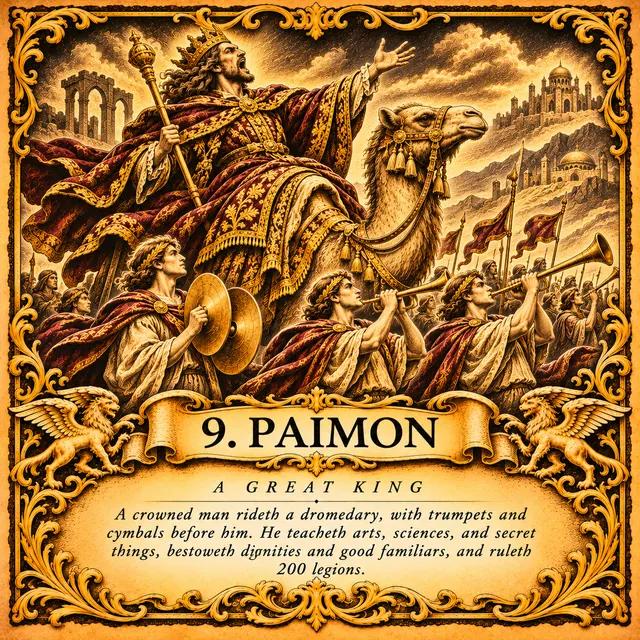
THE GOETIA · SPIRIT 9 OF 72 · KING
Paimon
Knowledge in the presence of authority
Also spelt Paymon
King Sun · 200 legions
HOW IT APPEARS
A crowned man on a dromedary, preceded by spirits with trumpets and cymbals; roars on arrival.
WHAT IT DOES
Teaches all arts, sciences and secret things, gives dignities and good familiars.
Teaching & knowledgeHonours & favourFamiliars
Said to be very obedient to Lucifer.
Paimon brings learning, ceremony and commanding presence together, inviting reflection on how authority shapes what people hear and believe.
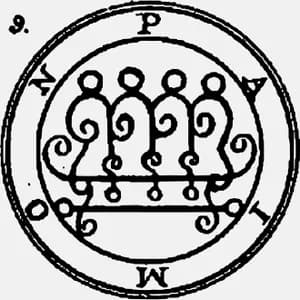
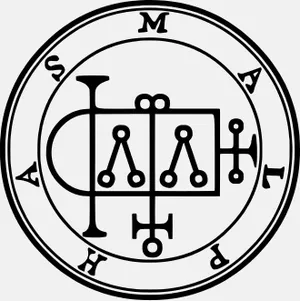
The seal of Paimon
The seal, or sigil, as the 1904 edition printed it, to be worn before the magician as a lamen. The Goetia asks for each seal to be made in the metal of the spirit's rank: for a king, gold.
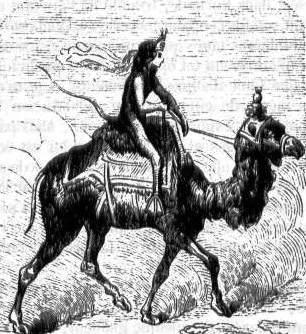
In the Sloane manuscript
The Goetia presents Paimon as a crowned king riding a dromedary, preceded by musicians and speaking with an overwhelming voice. His offices include teaching arts and sciences, revealing secrets, granting dignities and making people subject to another's authority. Goetia, spirit 9, Sloane MS 3825
A seventeenth-century manuscript of the Goetia, which can differ in spelling and detail from the 1904 edition given above.
Rank, legions and the angel against it
- RANK, PLANET AND SEAL
King: ☉ Sun, its seal made in gold
- LEGIONS UNDER IT
- 200Paimon has the most, 200.
- WHEN THE GOETIA SAYS TO CALL IT
Kings: 9 a.m. to noon, and 3 p.m. to sunset
- THE ANGEL SET AGAINST IT
- Haziel הזיאל, the ninth of the 72 angels of the Shem ha-Mephorash, of the Cherubim. In Dr Rudd's Goetia each spirit is bound by the angel of the same number.
- IN THE OLDER LISTS
- In Weyer's Pseudomonarchia Daemonum (1577); also spelt Paymon in Weyer, the manuscripts and the 1904 edition.
WRITTEN FOR OCCULTUM
A reading of Paimon
A SYMBOLIC READING
The spectacle offers a symbolic question about the difference between understanding and submission. Paimon invites examination of the way confidence, ceremony and reputation affect an audience. A powerful teacher or leader may open a field of knowledge; the listener still needs room to ask, test and reach an independent judgement.
A PRACTICE
Recall an explanation that impressed you because of who delivered it. Restate its main claim without the speaker's name or status. Identify what evidence supports it and a question you would ask if reputation were no obstacle.
AN ORIGINAL INVOCATION
Paimon, as I contemplate the splendour of authority, let learning deepen my judgement and leave my capacity to question intact.
A line for contemplation, newly written: not a conjuration from the Goetia.
TO REFLECT ON
What persuades me here: the explanation, the evidence or the presence of the speaker?
Historical description after Joseph H. Peterson's digital edition of the Lemegeton, Part 1: Goetia, a transcription of British Library Sloane MS 3825, offered under CC BY 4.0; the English here is a new paraphrase. Heading, summary, symbolic reading, practice, invocation and question: original editorial writing for Occultum.
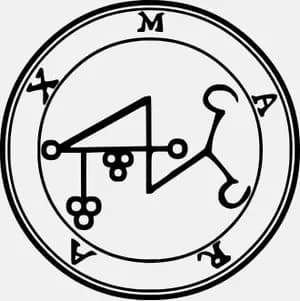
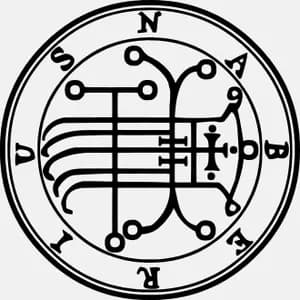
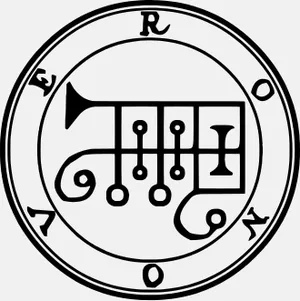
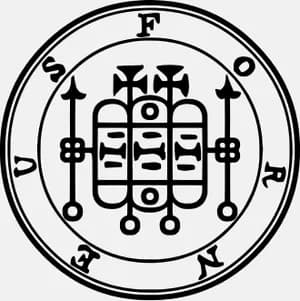
Spirits of like office
The spirits that share most of what Paimon is said to do.
Learn more in the lessons
- Demonology — A Short History · 17 min
- The Goetia — The 72 Spirits of Solomon · 18 min
- One Spirit, Three Texts · 13 min · free
- Discernment & Protection · to read before any practical spirit work
The Goetia asks for each seal to be made in the metal of the spirit's rank. Given here as history and symbolism, not as instructions.