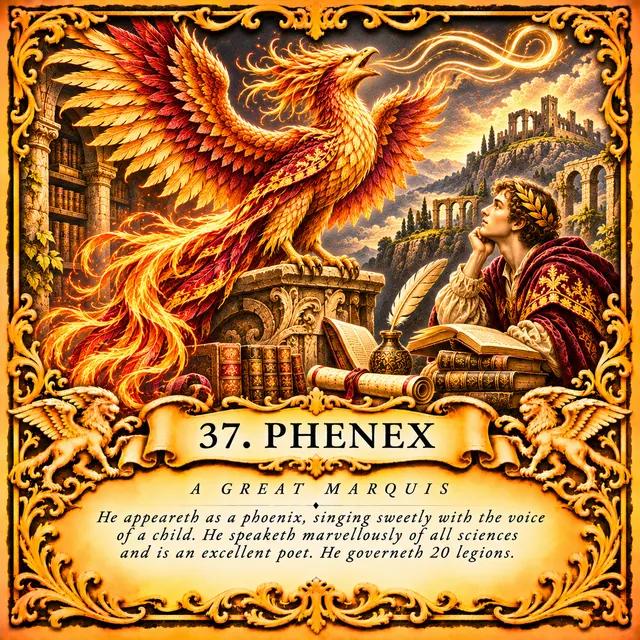
THE GOETIA · SPIRIT 37 OF 72 · MARQUIS
Phenex
The voice beneath an enchanting performance
Also spelt Pheynix, Phoenix
Marquis Moon · 20 legions
HOW IT APPEARS
A phoenix, singing sweetly with a child's voice.
WHAT IT DOES
Speaks marvellously of all sciences and is an excellent poet.
Teaching & knowledge
Hoped to return to the Seventh Throne after 1,200 years.
Phenex brings song, poetry and a striking change of voice into a reflection on the relationship between imaginative attraction and understanding.
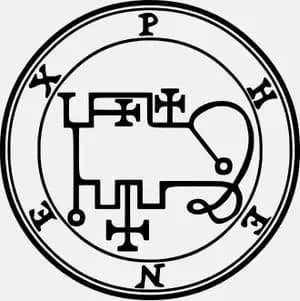
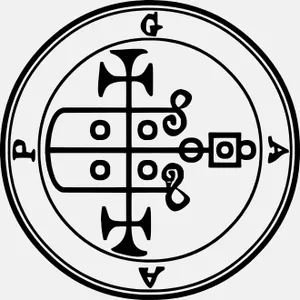
The seal of Phenex
The seal, or sigil, as the 1904 edition printed it, to be worn before the magician as a lamen. The Goetia asks for each seal to be made in the metal of the spirit's rank: for a marquis, silver.
In the Sloane manuscript
The Goetia's Phoenix appears as the mythical bird, sings with a child's voice and later takes human form. He speaks about sciences, is described as an excellent poet and expresses a distant hope of return to a heavenly throne. Goetia, spirit 37, Sloane MS 3825
A seventeenth-century manuscript of the Goetia, which can differ in spelling and detail from the 1904 edition given above.
Rank, legions and the angel against it
- RANK, PLANET AND SEAL
Marquis: ☽ Moon, its seal made in silver
- LEGIONS UNDER IT
- 20Paimon has the most, 200.
- WHEN THE GOETIA SAYS TO CALL IT
Marquises: 3 p.m. to sunrise
- THE ANGEL SET AGAINST IT
- Aniel אניאל, the 37th of the 72 angels of the Shem ha-Mephorash, of the Powers. In Dr Rudd's Goetia each spirit is bound by the angel of the same number.
- IN THE OLDER LISTS
- In Weyer's Pseudomonarchia Daemonum (1577); also spelt Pheynix, Phoenix in Weyer, the manuscripts and the 1904 edition.
WRITTEN FOR OCCULTUM
A reading of Phenex
A SYMBOLIC READING
Symbolically, the captivating performance can open attention while also becoming the thing that holds it in place. Phenex invites the listener to ask what remains when the music pauses: an idea, a feeling, a question or simply the wish to hear more. Art gains depth when enjoyment can lead into reflection.
A PRACTICE
Read a poem or listen to a short piece of music twice. First attend to its immediate effect; then identify a specific choice of image, rhythm or sound that helps create it. Write what the work invites you to consider beyond its first impression.
AN ORIGINAL INVOCATION
Phenex, let beauty sharpen my attention and help an enchanting voice lead towards thoughtful imagination, close listening and a meaning I can examine.
A line for contemplation, newly written: not a conjuration from the Goetia.
TO REFLECT ON
What remains with me after the performance has ended?
Historical description after Joseph H. Peterson's digital edition of the Lemegeton, Part 1: Goetia, a transcription of British Library Sloane MS 3825, offered under CC BY 4.0; the English here is a new paraphrase. Heading, summary, symbolic reading, practice, invocation and question: original editorial writing for Occultum.
Spirits of like office
The spirits that share most of what Phenex is said to do.



Learn more in the lessons
- The Goetia — The 72 Spirits of Solomon · 18 min
- One Spirit, Three Texts · 13 min · free
- Inside the Goetia — How a Book of Spirits Works · 30 min
- Discernment & Protection · to read before any practical spirit work
The Goetia asks for each seal to be made in the metal of the spirit's rank. Given here as history and symbolism, not as instructions.