MINOR ARCANA · SWORDS · AIR
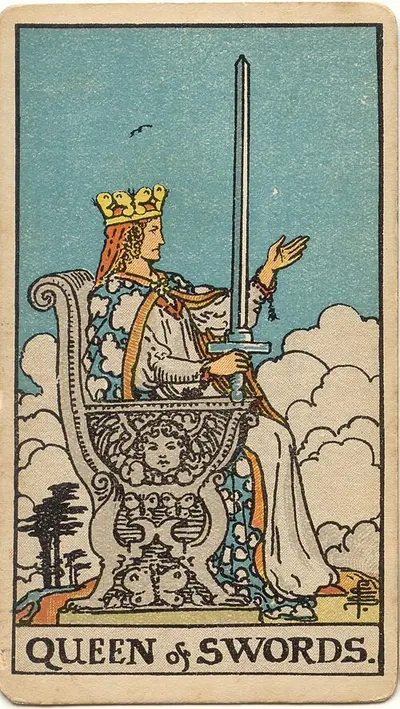
Queen of Swords
Tarot card meaning
UPRIGHT
Independence, clear boundaries, honesty.
REVERSED
Coldness, bitterness, cruelty.
The card
The Queen of Swords is one of the four court cards of Swords, the suit of Air: thought, conflict and truth.
In the Golden Dawn's scheme each court card is an element within its suit's element: the Queen of Swords is Water of Air.
In Aleister Crowley's Thoth tarot: The Queen of Swords. Crowley's courts are Knight, Queen, Prince and Princess, so this is the card the Rider–Waite–Smith deck calls the Queen.
In Waite's words
Arthur Edward Waite designed the deck that Pamela Colman Smith drew, and explained it in The Pictorial Key to the Tarot (1911). His text, with his spelling:
Her right hand raises the weapon vertically and the hilt rests on an arm of her royal chair; the left hand is extended, the arm raised; her countenance is severe but chastened; it suggests familiarity with sorrow. It does not represent mercy, and, her sword notwithstanding, she is scarcely a symbol of power. DIVINATORY MEANINGS Widowhood, female sadness and embarrassment, absence, sterility, mourning, privation, separation. REVERSED Malice, bigotry, artifice, prudery, bale, deceit.
FURTHER MEANINGS A widow. REVERSED A bad woman, with ill-will towards the Querent.
A. E. Waite, The Pictorial Key to the Tarot (London: William Rider & Son, 1911), Part III §§ 2 and 4. Public domain; text from the 1922 printing on Wikisource.
Related cards
The same card in the other suits
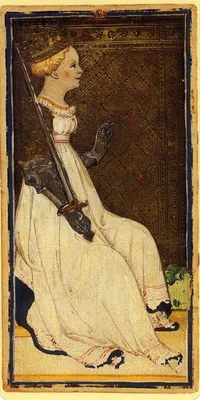
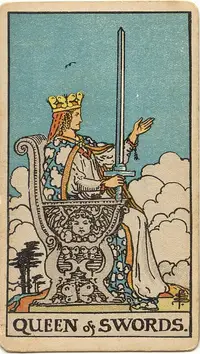
In three historical decks
The same card as it was painted in fifteenth-century Milan, printed in the French pattern of the Tarot de Marseille, and drawn by Pamela Colman Smith for the Rider–Waite–Smith deck.
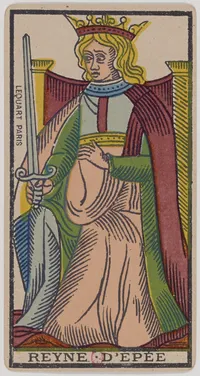
In the Tarot de Marseille: Reine (the queen) of Épées (swords).
Learn more in the lessons
- Reading the Court Cards · 16 min
- The Tarot & the Stars — Decans, Pips & Courts · 16 min
- The Structure of the Tarot · 14 min · free
Images: Pamela Colman Smith, 1909 (public domain); the RWS1909 scans on Wikimedia Commons. Lequart, Paris, c. 1890 (public domain); scans from the Bibliothèque nationale de France (Gallica), via Wikimedia Commons. Attributed to Bonifacio Bembo, mid-15th century (public domain); scans by David Madore, via Wikimedia Commons.