MAJOR ARCANA · TRUMP IV
The Emperor
Tarot card meaning
UPRIGHT
Structure, authority, stability, protective leadership.
REVERSED
Rigidity, domination, lack of discipline.
The card
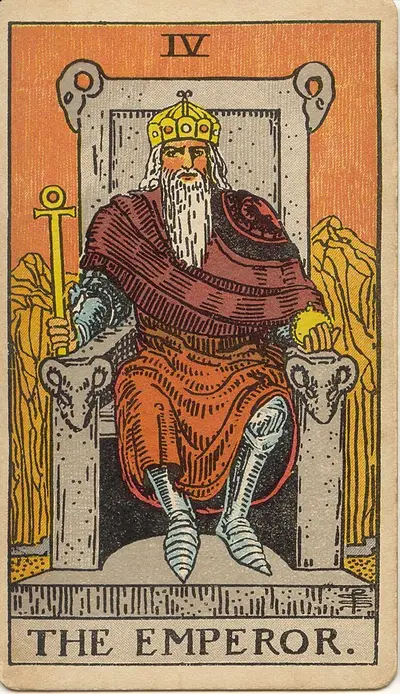
A bearded ruler in armour sits on a stone throne carved with rams' heads, holding an ankh sceptre and an orb, before barren mountains.
The Emperor is trump IV of the twenty-two trumps of the Major Arcana.
In the Golden Dawn's attributions it carries the Hebrew letter Heh (ה), “window”, and the sign of Aries. On the Tree of Life it is path 15, joining Chokmah and Tiphareth.
In Aleister Crowley's Thoth tarot: The Emperor, IV.
In Waite's words
Arthur Edward Waite designed the deck that Pamela Colman Smith drew, and explained it in The Pictorial Key to the Tarot (1911). His text, with his spelling:
DIVINATORY MEANINGS Stability, power, protection, realization; a great person; aid, reason, conviction; also authority and will.
REVERSED Benevolence, compassion, credit; also confusion to enemies, obstruction, immaturity.
The picture and its symbolism
He has a form of the Crux ansata for his sceptre and a globe in his left hand. He is a crowned monarch—commanding, stately, seated on a throne, the arms of which are fronted by rams' heads. He is executive and realization, the power of this world, here clothed with the highest of its natural attributes. He is occasionally represented as seated on a cubic stone, which, however, confuses some of the issues. He is the virile power, to which the Empress responds, and in this sense is he who seeks to remove the Veil of Isis; yet she remains virgo intacta.
It should be understood that this card and that of the Empress do not precisely represent the condition of married life, though this state is implied. On the surface, as I have indicated, they stand for mundane royalty, uplifted on the seats of the mighty; but above this there is the suggestion of another presence. They signify also—and
the male figure especially—the higher kingship, occupying the intellectual throne. Hereof is the lordship of thought rather than of the animal world. Both personalities, after their own manner, are "full of strange experience," but theirs is not consciously the wisdom which draws from a higher world. The Emperor has been described as (a) will in its embodied form, but this is only one of its applications, and (b) as an expression of virtualities contained in the Absolute Being—but this is fantasy.
A. E. Waite, The Pictorial Key to the Tarot (London: William Rider & Son, 1911), Part II § 2 and Part III § 3. Public domain; text from the 1922 printing on Wikisource.
Related cards
The numbered cards it governs
Two of Wands: a decan of Aries · Three of Wands: a decan of Aries · Four of Wands: a decan of Aries
In three historical decks
The same card as it was painted in fifteenth-century Milan, printed in the French pattern of the Tarot de Marseille, and drawn by Pamela Colman Smith for the Rider–Waite–Smith deck.
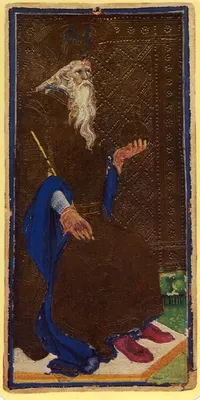
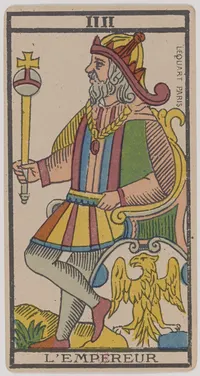
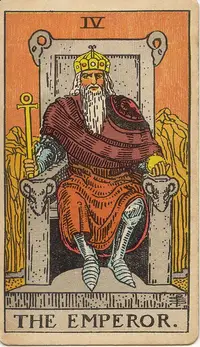
In the Tarot de Marseille: L'Empereur, IV.
Learn more in the lessons
- The Thoth Tarot · 12 min
- The Twenty-Two Paths & the Tarot · 18 min
- The Major Arcana Journey · 18 min
Images: Pamela Colman Smith, 1909 (public domain); the RWS1909 scans on Wikimedia Commons. Lequart, Paris, c. 1890 (public domain); scans from the Bibliothèque nationale de France (Gallica), via Wikimedia Commons. Attributed to Bonifacio Bembo, mid-15th century (public domain); scans by David Madore, via Wikimedia Commons.