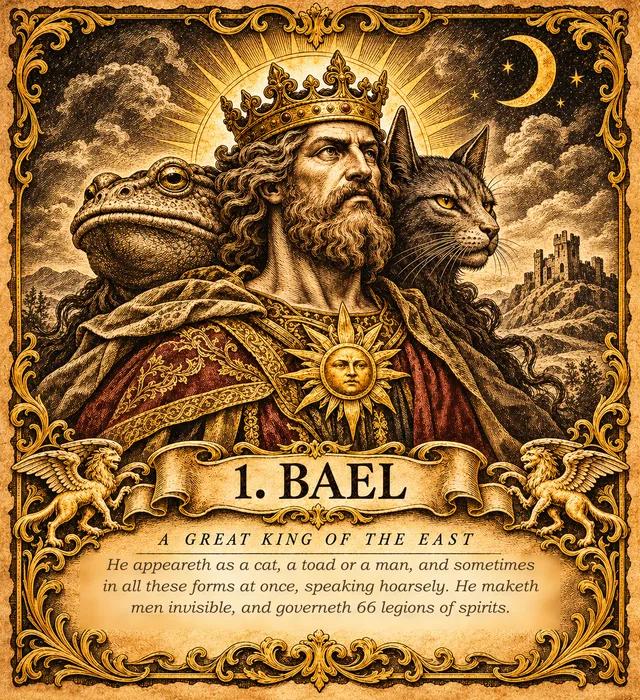
THE GOETIA · SPIRIT 1 OF 72 · KING
Bael
The question of being seen
Also spelt Baal
King Sun · 66 legions
HOW IT APPEARS
In divers shapes: a cat, a toad or a man, and sometimes all of them at once; speaks hoarsely.
WHAT IT DOES
Makes people invisible.
King of the East. Weyer's list (1577) gives him instead three heads, of a toad, a man and a cat, and makes him wise as well as invisible. His name descends from the Canaanite god Baal.
Bael opens the sequence with an image of divided appearances and invisibility, inviting reflection on presence, concealment and the uses of attention.
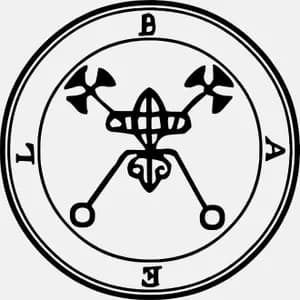
The seal of Bael
The seal, or sigil, as the 1904 edition printed it, to be worn before the magician as a lamen. The Goetia asks for each seal to be made in the metal of the spirit's rank: for a king, gold.
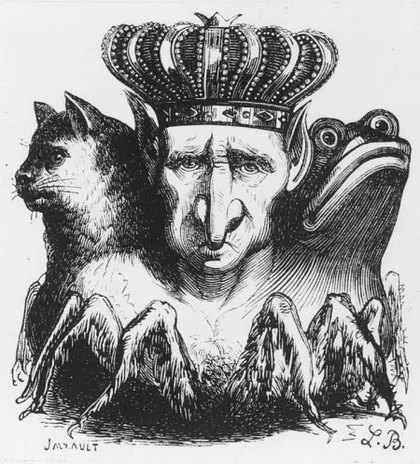
In the Sloane manuscript
The Goetia describes Bael as an eastern king who appears as a cat, a toad, a man or a combination of these forms. His voice is hoarse, and his stated office is to make a person invisible. Goetia, spirit 1, Sloane MS 3825
A seventeenth-century manuscript of the Goetia, which can differ in spelling and detail from the 1904 edition given above.
Rank, legions and the angel against it
- RANK, PLANET AND SEAL
King: ☉ Sun, its seal made in gold
- LEGIONS UNDER IT
- 66Paimon has the most, 200.
- WHEN THE GOETIA SAYS TO CALL IT
Kings: 9 a.m. to noon, and 3 p.m. to sunset
- THE ANGEL SET AGAINST IT
- Vehuiah והויה, the first of the 72 angels of the Shem ha-Mephorash, of the Seraphim. In Dr Rudd's Goetia each spirit is bound by the angel of the same number.
- IN THE OLDER LISTS
- In Weyer's Pseudomonarchia Daemonum (1577); also spelt Baal in Weyer, the manuscripts and the 1904 edition.
WRITTEN FOR OCCULTUM
A reading of Bael
A SYMBOLIC READING
The changing faces offer a symbolic way to consider how identity is presented in different settings. Invisibility raises a further question: when does privacy protect something valuable, and when does concealment prevent responsibility? Bael's imagery can be used to examine the wish to control how much of oneself the world encounters.
A PRACTICE
Choose a situation in which you feel either overexposed or overlooked. Describe what you want others to understand and what you reasonably wish to keep private. Make one clear adjustment in how you communicate that boundary.
AN ORIGINAL INVOCATION
Bael, as I contemplate your changing forms, let me recognise when to step forward and when to preserve a thoughtful privacy.
A line for contemplation, newly written: not a conjuration from the Goetia.
TO REFLECT ON
What do I want my presence, or my absence, to accomplish?
Historical description after Joseph H. Peterson's digital edition of the Lemegeton, Part 1: Goetia, a transcription of British Library Sloane MS 3825, offered under CC BY 4.0; the English here is a new paraphrase. Heading, summary, symbolic reading, practice, invocation and question: original editorial writing for Occultum.
Learn more in the lessons
- One Spirit, Three Texts · 13 min · free
- Demonology — A Short History · 17 min
- The Goetia — The 72 Spirits of Solomon · 18 min
- Inside the Goetia — How a Book of Spirits Works · 30 min
- The Seventy-Two Angels · 15 min
- Discernment & Protection · to read before any practical spirit work
The Goetia asks for each seal to be made in the metal of the spirit's rank. Given here as history and symbolism, not as instructions.