THE GOETIA · SPIRIT 69 OF 72 · MARQUIS
Decarabia
Attending to the living original
Also spelt Carabia
Marquis Moon · 30 legions
HOW IT APPEARS
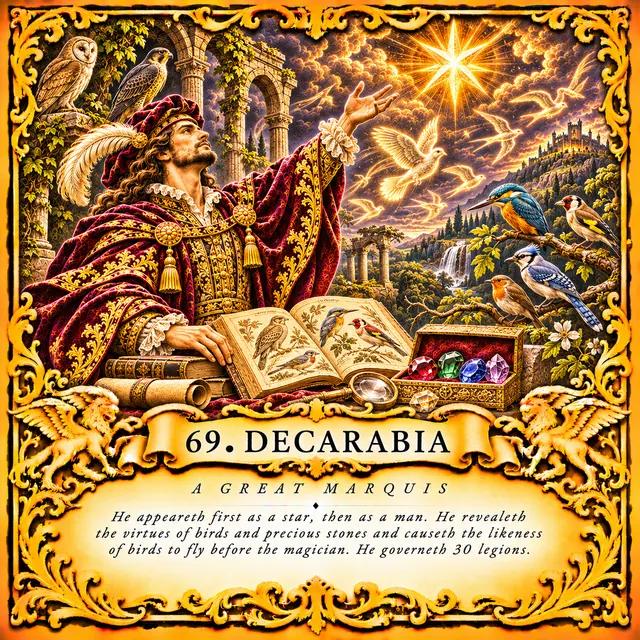
A star in a pentacle, then a man.
WHAT IT DOES
Reveals the virtues of birds and precious stones (herbs in the Sloane manuscript and in Weyer) and makes illusory birds fly before the magician.
Teaching & knowledge
Weyer's Latin calls him a great king and earl, which Scot leaves out; the Sloane manuscript and the 1904 edition make him a marquis.
Decarabia brings plant and stone lore together with convincing bird-like appearances, inviting reflection on the relationship between a representation and the life it depicts.
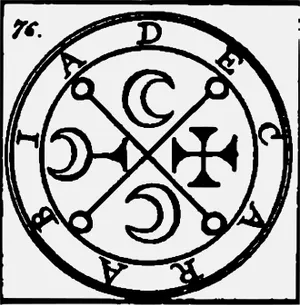
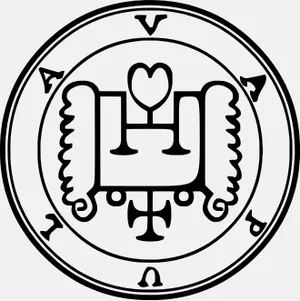
The seal of Decarabia
The seal, or sigil, as the 1904 edition printed it, to be worn before the magician as a lamen. The Goetia asks for each seal to be made in the metal of the spirit's rank: for a marquis, silver.
In the Sloane manuscript
The Goetia describes Decarabia first in star form and afterwards as a man. He reveals the properties of herbs and precious stones and produces likenesses of birds that fly, remain nearby, sing and drink as natural birds do. Goetia, spirit 69, Sloane MS 3825
A seventeenth-century manuscript of the Goetia, which can differ in spelling and detail from the 1904 edition given above.
Rank, legions and the angel against it
- RANK, PLANET AND SEAL
Marquis: ☽ Moon, its seal made in silver
- LEGIONS UNDER IT
- 30Paimon has the most, 200.
- WHEN THE GOETIA SAYS TO CALL IT
Marquises: 3 p.m. to sunrise
- THE ANGEL SET AGAINST IT
- Roehel ראהאל, the 69th of the 72 angels of the Shem ha-Mephorash, of the Angels. In Dr Rudd's Goetia each spirit is bound by the angel of the same number.
- IN THE OLDER LISTS
- In Weyer's Pseudomonarchia Daemonum (1577); also spelt Carabia in Weyer, the manuscripts and the 1904 edition.
WRITTEN FOR OCCULTUM
A reading of Decarabia
A SYMBOLIC READING
An original symbolic interpretation can explore the attention given to an image that resembles its subject. A convincing likeness can help us study, imagine or remember, while the original retains a setting and complexity that the image may omit. Decarabia invites curiosity about the living world beyond the patterns through which it is represented.
A PRACTICE
Choose a natural subject you usually encounter through pictures or descriptions. Observe an accessible example directly, or consult a detailed natural-history account. Record one feature that your familiar representation leaves out and consider how it changes your understanding.
AN ORIGINAL INVOCATION
Decarabia, let the image lead me towards a closer attention, let beauty deepen curiosity, and let the living subject retain its richness beyond my representation of it.
A line for contemplation, newly written: not a conjuration from the Goetia.
TO REFLECT ON
What has this familiar image taught me to overlook in its subject?
Historical description after Joseph H. Peterson's digital edition of the Lemegeton, Part 1: Goetia, a transcription of British Library Sloane MS 3825, offered under CC BY 4.0; the English here is a new paraphrase. Heading, summary, symbolic reading, practice, invocation and question: original editorial writing for Occultum.
Spirits of like office
The spirits that share most of what Decarabia is said to do.
Learn more in the lessons
- The Goetia — The 72 Spirits of Solomon · 18 min
- One Spirit, Three Texts · 13 min · free
- Inside the Goetia — How a Book of Spirits Works · 30 min
- Discernment & Protection · to read before any practical spirit work
The Goetia asks for each seal to be made in the metal of the spirit's rank. Given here as history and symbolism, not as instructions.