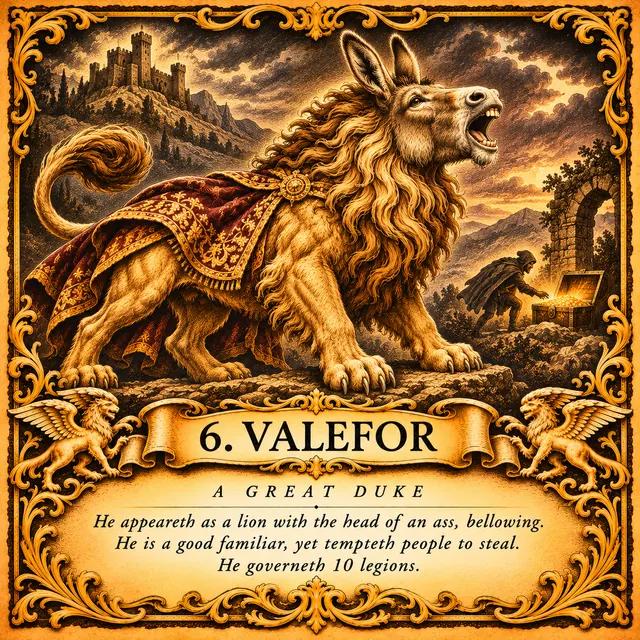
THE GOETIA · SPIRIT 6 OF 72 · DUKE
Valefor
The cost hidden inside a favour
Also spelt Malaphar
Duke Venus · 10 legions
HOW IT APPEARS
A lion with an ass's head, bellowing (so the 1904 edition; the manuscripts give him a man's head, scowling or howling, and Weyer the head of a thief).
WHAT IT DOES
A good familiar — but tempts people to steal, and in Weyer's account leads them to the gallows.
Familiars
Valefor presents companionship alongside temptation, making trust, influence and the price of a convenient advantage natural subjects for reflection.
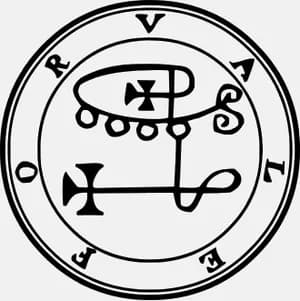
The seal of Valefor
The seal, or sigil, as the 1904 edition printed it, to be worn before the magician as a lamen. The Goetia asks for each seal to be made in the metal of the spirit's rank: for a duke, copper.
In the Sloane manuscript
The Goetia's Valefar appears as a lion with a human head and is described as a useful familiar. The same passage says that he tempts those close to him to steal, placing help and wrongdoing within one portrait. Goetia, spirit 6, Sloane MS 3825
A seventeenth-century manuscript of the Goetia, which can differ in spelling and detail from the 1904 edition given above.
Rank, legions and the angel against it
- RANK, PLANET AND SEAL
Duke: ♀ Venus, its seal made in copper
- LEGIONS UNDER IT
- 10Paimon has the most, 200.
- WHEN THE GOETIA SAYS TO CALL IT
Dukes: sunrise to noon, in clear weather
- THE ANGEL SET AGAINST IT
- Lelahel ללהאל, the sixth of the 72 angels of the Shem ha-Mephorash, of the Seraphim. In Dr Rudd's Goetia each spirit is bound by the angel of the same number.
- IN THE OLDER LISTS
- In Weyer's Pseudomonarchia Daemonum (1577); also spelt Malaphar in Weyer, the manuscripts and the 1904 edition.
WRITTEN FOR OCCULTUM
A reading of Valefor
A SYMBOLIC READING
The symbolic tension concerns the way a benefit can make its conditions easier to overlook. Valefor invites examination of a favour that compromises judgement, an alliance that discourages questions or an advantage obtained at someone else's expense. Familiarity does not remove the need to consider what an action actually does.
A PRACTICE
Review an advantage or favour you are being offered. State its conditions plainly, including any unspoken expectation. Ask who may carry a cost that has not been acknowledged, and decide what boundary would preserve your ability to choose freely.
AN ORIGINAL INVOCATION
Valefor, as I consider the temptation within a favour, let me recognise its cost and keep my judgement independent of convenience.
A line for contemplation, newly written: not a conjuration from the Goetia.
TO REFLECT ON
What am I being encouraged to overlook because the offer is useful?
Historical description after Joseph H. Peterson's digital edition of the Lemegeton, Part 1: Goetia, a transcription of British Library Sloane MS 3825, offered under CC BY 4.0; the English here is a new paraphrase. Heading, summary, symbolic reading, practice, invocation and question: original editorial writing for Occultum.
Spirits of like office
The spirits that share most of what Valefor is said to do.
Learn more in the lessons
- The Goetia — The 72 Spirits of Solomon · 18 min
- One Spirit, Three Texts · 13 min · free
- Inside the Goetia — How a Book of Spirits Works · 30 min
- Discernment & Protection · to read before any practical spirit work
The Goetia asks for each seal to be made in the metal of the spirit's rank. Given here as history and symbolism, not as instructions.