THE GOETIA · SPIRIT 3 OF 72 · PRINCE
Vassago
Following a question into uncertainty
Prince Jupiter · 26 legions
HOW IT APPEARS
Of the same nature as Agares.
WHAT IT DOES
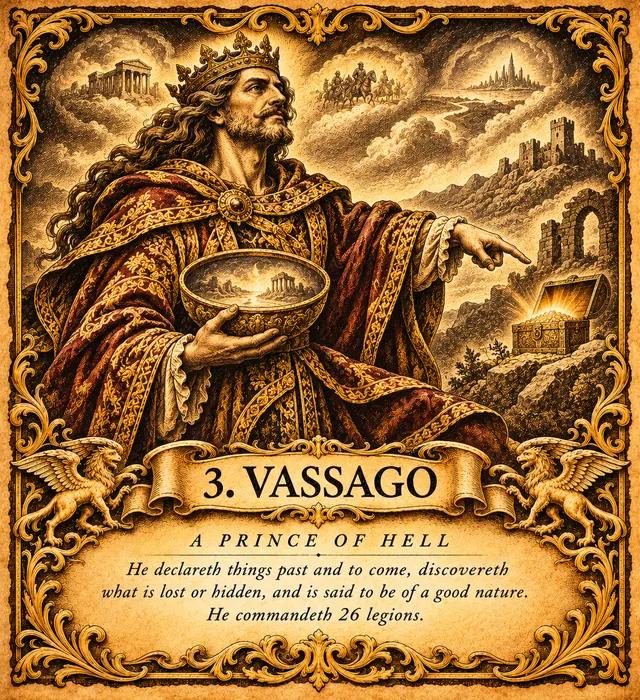
Declares things past and to come, and finds things lost or hidden. Said to be of a good nature.
Past & futureLost & hidden things
Popular with scryers.
Vassago offers a focus for enquiry into what is hidden or missing, with particular attention to the difference between a question and its hoped-for answer.
The seal of Vassago
The seal, or sigil, as the 1904 edition printed it, to be worn before the magician as a lamen. The Goetia asks for each seal to be made in the metal of the spirit's rank: for a prince, tin.

In the Sloane manuscript
The Goetia describes Vassago as a prince of good nature whose offices concern past and future events and the discovery of hidden or lost things. It provides little independent detail about his appearance. Vassago is absent from Weyer's earlier catalogue. Goetia, spirit 3, Sloane MS 3825 · Weyer, 1577
A seventeenth-century manuscript of the Goetia, which can differ in spelling and detail from the 1904 edition given above.
Rank, legions and the angel against it
- RANK, PLANET AND SEAL
Prince: ♃ Jupiter, its seal made in tin
- LEGIONS UNDER IT
- 26Paimon has the most, 200.
- WHEN THE GOETIA SAYS TO CALL IT
Princes: any hour of the day
- THE ANGEL SET AGAINST IT
- Sitael סיטאל, the third of the 72 angels of the Shem ha-Mephorash, of the Seraphim. In Dr Rudd's Goetia each spirit is bound by the angel of the same number.
- IN THE OLDER LISTS
- Not in Johann Weyer's Pseudomonarchia Daemonum (1577): one of the four spirits the Goetia adds.
WRITTEN FOR OCCULTUM
A reading of Vassago
A SYMBOLIC READING
Symbolically, the missing object can stand for an overlooked fact, a forgotten connection or a question that has not been stated clearly. Vassago invites curiosity without requiring uncertainty to be filled immediately. The value of an enquiry can lie in the accuracy of its next question.
A PRACTICE
Write a question you genuinely want to investigate. Separate what is known from what is assumed, and identify one source or observation that could add useful information. Record an unexpected result as carefully as a result you hoped to find.
AN ORIGINAL INVOCATION
Vassago, let my questions become clearer and help me follow uncertainty with patient attention, honest records and an open mind.
A line for contemplation, newly written: not a conjuration from the Goetia.
TO REFLECT ON
What would I investigate if I were willing to be surprised?
Historical description after Joseph H. Peterson's digital edition of the Lemegeton, Part 1: Goetia, a transcription of British Library Sloane MS 3825, offered under CC BY 4.0; the English here is a new paraphrase. Heading, summary, symbolic reading, practice, invocation and question: original editorial writing for Occultum.
Spirits of like office
The spirits that share most of what Vassago is said to do.




Learn more in the lessons
- The Goetia — The 72 Spirits of Solomon · 18 min
- One Spirit, Three Texts · 13 min · free
- Inside the Goetia — How a Book of Spirits Works · 30 min
- Discernment & Protection · to read before any practical spirit work
The Goetia asks for each seal to be made in the metal of the spirit's rank. Given here as history and symbolism, not as instructions.