THE I CHING · HEXAGRAM 17 OF 64
Hexagram 17: Following
隨 Suí
☱ Lake above, ☳ Thunder below · its trigrams ↓
Thunder in the middle of the lake: rest at evening.
To be followed, first follow: adapt to the time and the people, in a way that is right and without fault.
COUNSEL Adapt to the time and win others' trust by it.
The Judgment and the lines
In James Legge's translation of 1882. Tradition gives the Judgment, the text on the whole figure, to King Wen, and the texts of the six lines to his son, the Duke of Zhou. The words in brackets are Legge's own, filling out the terse Chinese.
THE JUDGMENT
Sui indicates that (under its conditions) there will be great progress and success. But it will be advantageous to be firm and correct. There will (then) be no error.
THE SIX LINES, FROM THE BOTTOM UP
LINE 1 · THE BEGINNING · SOLID
The first NINE, undivided, shows us one changing the object of his pursuit; but if he be firm and correct, there will be good fortune. Going beyond (his own) gate to find associates, he will achieve merit.
Changing, it becomes 45. Gathering Together.
LINE 2 · THE INNER PLACE · BROKEN
The second SIX, divided, shows us one who cleaves to the little boy, and lets go the man of age and experience.
Changing, it becomes 58. The Joyous.
LINE 3 · THE THRESHOLD · BROKEN
The third SIX, divided, shows us one who cleaves to the man of age and experience, and lets go the little boy. Such following will get what it seeks; but it will be advantageous to adhere to what is firm and correct.
Changing, it becomes 49. Revolution.
LINE 4 · THE APPROACH · SOLID
The fourth NINE, undivided, shows us one followed and obtaining (adherents). Though he be firm and correct, there will be evil. If he be sincere (however) in his course, and make that evident, into what error will he fall?
Changing, it becomes 3. Difficulty at the Beginning.
LINE 5 · THE RULER · SOLID
The fifth NINE, undivided, shows us (the ruler) sincere in (fostering all) that is excellent. There will be good fortune.
Changing, it becomes 51. The Arousing.
LINE 6 · THE END · BROKEN
The topmost SIX, divided, shows us (that sincerity) firmly held and clung to, yea, and bound fast. (We see) the king with it presenting his offerings on the western mountain.
Changing, it becomes 25. Innocence.
In a cast, a line's text is read when that line changes, and the hexagram it changes into shows where the matter is going; when several lines change, Zhu Xi's rules choose which texts to read, and the I Ching tool follows them. Legge's translation, volume XVI of The Sacred Books of the East (1882), as the Reading Room has it: hexagram 17, his Sui. Read it there with his note →
Its two trigrams
Lake above Thunder. The lower trigram is the inner situation and the upper the outer, and the hexagram's image is read from the two of them.

ABOVE☱ Lake 兌 Duì
Marsh, mist; joyous, open. In the family of the Shuogua it is the youngest daughter.
The misty lake
THE EIGHT WITH LAKE ABOVE
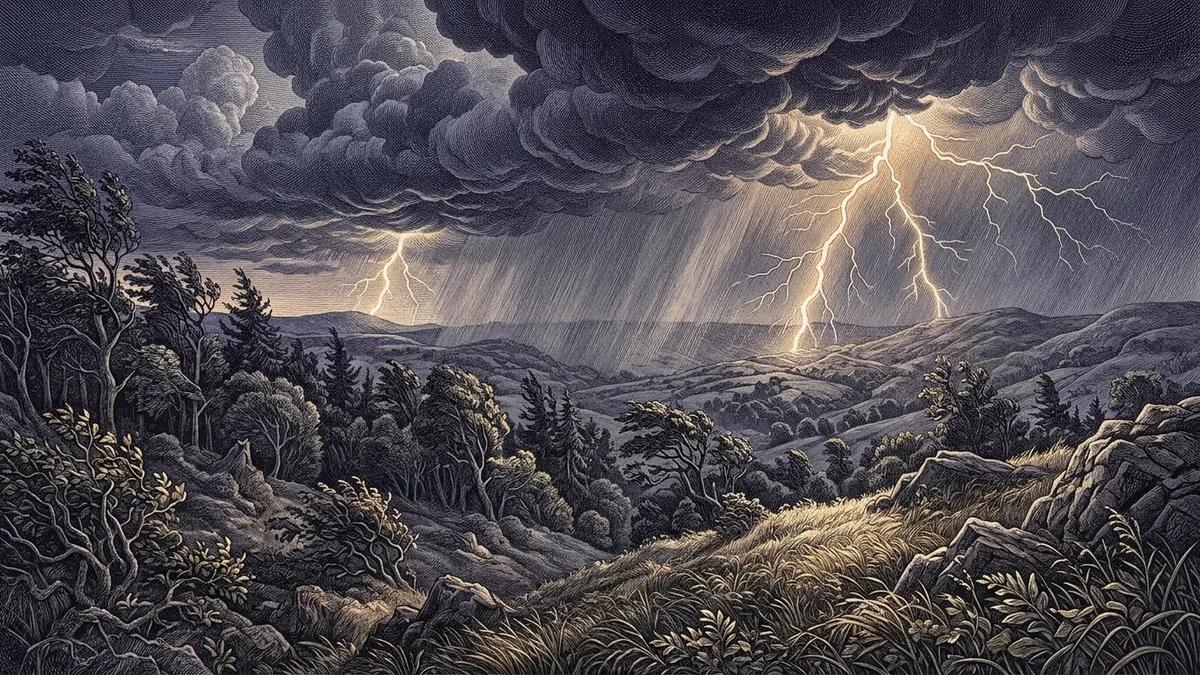
BELOW☳ Thunder 震 Zhèn
Thunder, quake; arousing, moving. In the family of the Shuogua it is the eldest son.
The breaking storm
THE EIGHT WITH THUNDER BELOW
Pictures: original AI illustration created for Occultum.
Its pair, its opposite and its core
King Wen's order sets the hexagrams in pairs, each the other turned upside down or, where that changes nothing, with every line changed. Inside each lies a third, its hidden core, made of its lines 2 to 4 and 3 to 5.
In binary, a solid line 1 and a broken 0, read from the bottom line: 100110, which is 38, its place in the order Shao Yong set out and Leibniz saw his binary arithmetic in.
Learn more in the lessons
- The Book of Changes · 18 min
- Yin, Yang and the Five Phases · 13 min · free
- The Sovereign Hexagrams and the Tide of the Year · 14 min
The English name is the common title. The image, sense and counsel are short plain-words summaries of the Judgment and the Image, written for Occultum's I Ching tool, not translations; the Judgment and lines are James Legge's, from The Sacred Books of the East, vol. XVI (1882). Given here as history and symbolism; see the lesson The Book of Changes for how the book grew.