THE GOETIA · SPIRIT 14 OF 72 · MARQUIS
Leraje
The wound that an argument leaves
Also spelt Leraikha, Loray
Marquis Moon · 30 legions
HOW IT APPEARS
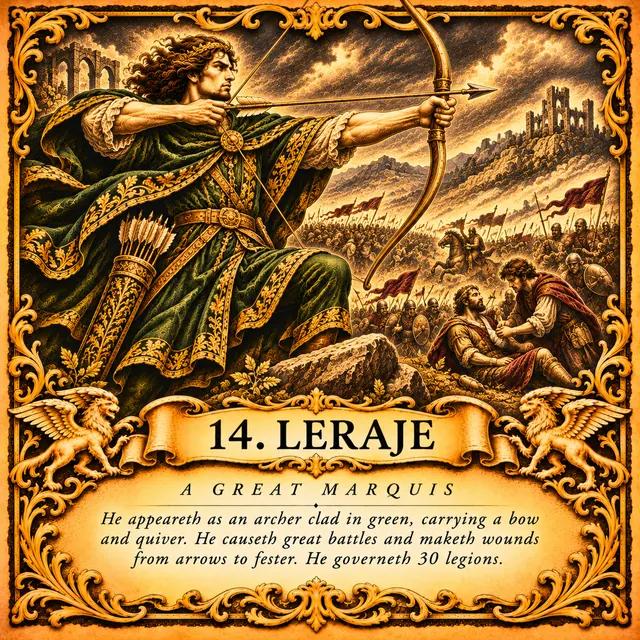
An archer clad in green, with bow and quiver.
WHAT IT DOES
Causes great battles and makes arrow wounds fester.
War & destruction
Leraje brings the imagery of archery and festering wounds into a reflection on conflict whose effects continue after the exchange has ended.
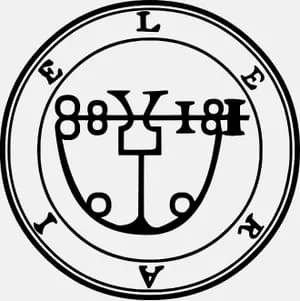
The seal of Leraje
The seal, or sigil, as the 1904 edition printed it, to be worn before the magician as a lamen. The Goetia asks for each seal to be made in the metal of the spirit's rank: for a marquis, silver.
In the Sloane manuscript
The Goetia describes Leraje as a green-clad archer carrying a bow and quiver. His assigned offices concern battles, contests and the corruption of wounds caused by arrows. Goetia, spirit 14, Sloane MS 3825
A seventeenth-century manuscript of the Goetia, which can differ in spelling and detail from the 1904 edition given above.
Rank, legions and the angel against it
- RANK, PLANET AND SEAL
Marquis: ☽ Moon, its seal made in silver
- LEGIONS UNDER IT
- 30Paimon has the most, 200.
- WHEN THE GOETIA SAYS TO CALL IT
Marquises: 3 p.m. to sunrise
- THE ANGEL SET AGAINST IT
- Mebahel מבהאל, the 14th of the 72 angels of the Shem ha-Mephorash, of the Cherubim. In Dr Rudd's Goetia each spirit is bound by the angel of the same number.
- IN THE OLDER LISTS
- In Weyer's Pseudomonarchia Daemonum (1577); also spelt Leraikha, Loray in Weyer, the manuscripts and the 1904 edition.
WRITTEN FOR OCCULTUM
A reading of Leraje
A SYMBOLIC READING
Read symbolically, the arrow can stand for a remark aimed precisely at another person's vulnerability. Leraje invites attention to the consequences that remain after an immediate victory: resentment, mistrust or a grievance repeatedly reopened. The image asks what kind of outcome is being pursued when language is chosen to injure.
A PRACTICE
Recall a recent disagreement and identify one sentence designed mainly to wound or humiliate. Write the underlying concern without the personal attack. If a repair is appropriate, acknowledge the effect of the original words before attempting to explain what you meant.
AN ORIGINAL INVOCATION
Leraje, as I consider the wound left by a well-aimed word, let me recognise its cost and choose a more responsible way to speak.
A line for contemplation, newly written: not a conjuration from the Goetia.
TO REFLECT ON
What would I say if my aim were to address the issue rather than injure the person?
Historical description after Joseph H. Peterson's digital edition of the Lemegeton, Part 1: Goetia, a transcription of British Library Sloane MS 3825, offered under CC BY 4.0; the English here is a new paraphrase. Heading, summary, symbolic reading, practice, invocation and question: original editorial writing for Occultum.
Spirits of like office
The spirits that share most of what Leraje is said to do.


Learn more in the lessons
- The Goetia — The 72 Spirits of Solomon · 18 min
- One Spirit, Three Texts · 13 min · free
- Inside the Goetia — How a Book of Spirits Works · 30 min
- Discernment & Protection · to read before any practical spirit work
The Goetia asks for each seal to be made in the metal of the spirit's rank. Given here as history and symbolism, not as instructions.